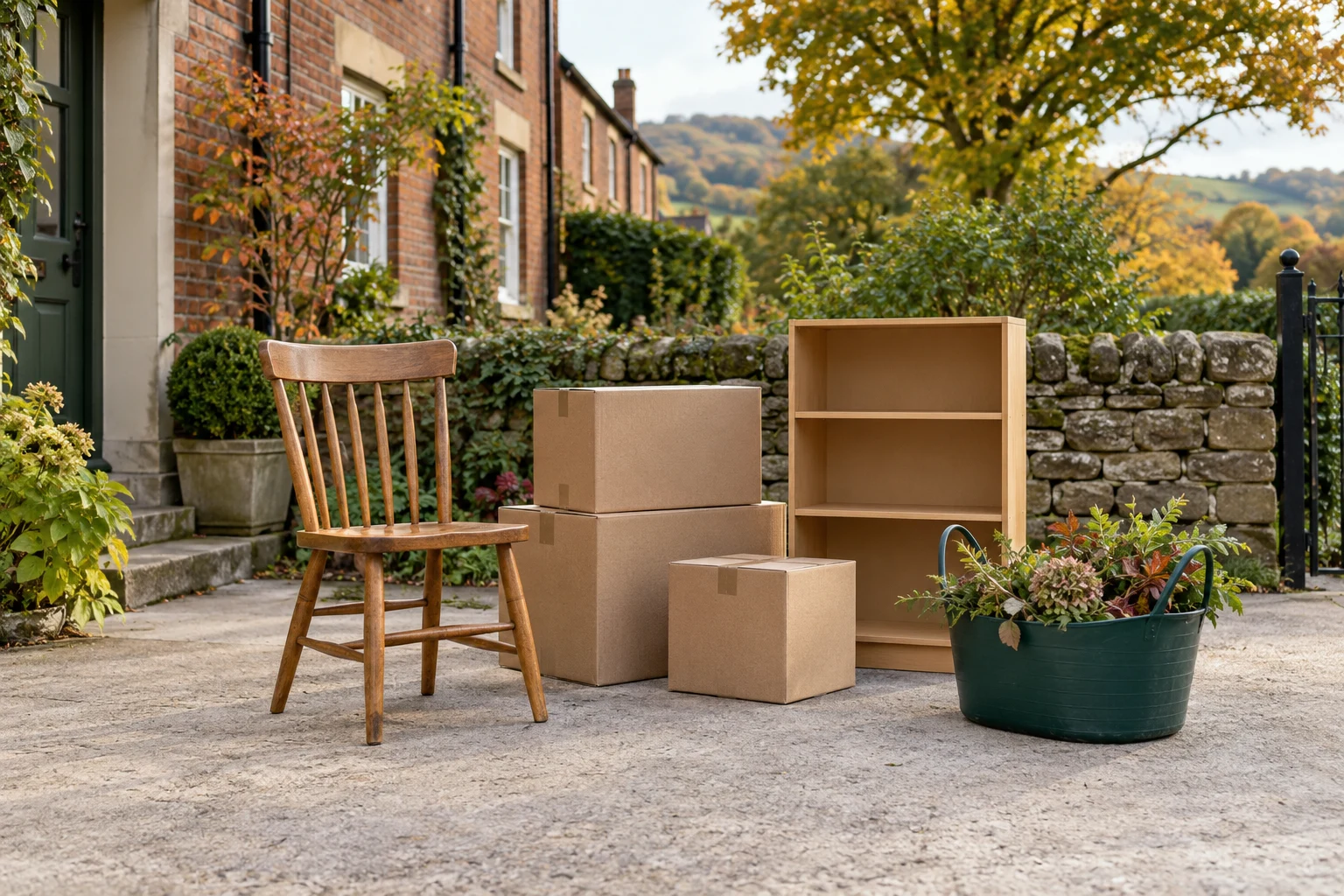
Furniture donation before house clearance: a realistic plan
Plan furniture donation before a West Yorkshire house clearance with honest condition checks, confirmed acceptance, transport and an accurate remaining waste list.

Furniture donation can reduce what needs to be collected as waste, but only when an item is genuinely suitable and somebody has agreed to receive it. A cupboard labelled for charity is not yet a completed donation. Before booking a house clearance, separate the items worth offering from those already needing a waste route, then keep the status of each offer visible until the handover happens.
For households in Leeds, Bradford, Wakefield, Huddersfield and Halifax, the practical challenge is usually timing. A replacement arrives, a move approaches or a relative needs help clearing a room. Reuse organisations have their own acceptance conditions and capacity. A realistic plan allows for that uncertainty without turning it into a reason to discard useful furniture immediately or a promise that everything will find another home.
GOV.UK’s household waste guidance includes giving away or selling reusable items among the available options. Kirklees Council’s bulky-waste page also places donation early in its staged approach and points to organisations and reuse facilities. Those are starting points for an enquiry, not acceptance of your particular wardrobe, sofa or dining set.
Decide what you are offering before contacting anyone
Make a short furniture list with a separate entry for each recognisable item or set. Record the type, approximate dimensions, condition and room location. Mark whether it belongs to you and is authorised to leave. Do not use a donation enquiry to decide what should happen to someone else’s possessions. Resolve permission through the appropriate family, ownership or estate process before inviting a recipient to collect.
Then give each entry one of three initial decisions: keep, offer for reuse or seek a waste route. A fourth pending status is useful where condition or permission is uncertain. Keep these decisions distinct from the later acceptance status. “Offer for reuse” means the household wants to explore that option; it does not mean the receiving organisation has seen the item or agreed to take it.
If several relatives are helping, nominate one person to maintain the list and communicate changes. Otherwise one person can promise an item to a charity while another includes it in a clearance quote. Give the list a date and version so everyone can identify the current instruction. The administrative effort is modest, but it protects both a useful item and the accuracy of the remaining waste enquiry.
Describe condition honestly and specifically
A useful description says what is visible rather than relying only on “good condition”. Explain whether doors and drawers are present, whether upholstery is marked, whether a table has all its pieces and whether an item has a noticeable defect. Photographs should support that account. Do not hide damaged areas beneath cushions or arrange an image so that the recipient cannot see the issue being discussed.
Keep the recipient’s decision separate from your own preference. Furniture can have sentimental value or still look attractive while being unsuitable for the particular organisation’s service. Space, resale criteria, construction and other acceptance conditions may matter. Ask what information the organisation needs and provide it accurately. A refusal is a route decision, not a judgement on the household or an invitation to conceal a defect from another recipient.
Where there is an infestation concern, unusual contamination or an unidentified problem, disclose it before arranging transport. Do not attempt a treatment simply to make a donation enquiry easier. Ask for appropriate advice and keep the item outside a routine offer until the issue is understood. This article helps organise enquiries; it does not certify safety or suitability from a photograph.
Photograph the item and the collection task
Use a clear overall image, useful detail views and a written dimension note. For a cabinet, show its full shape and any visible damage; for a dining set, show the table and the actual chair count. Separate the item photograph from the access photograph. A recipient deciding whether it wants the furniture and a team deciding whether it can move the furniture are answering different questions.
Keep private documents, names on boxes and personal screens out of shared images. A house clearance can expose correspondence and family information even when the subject of the photograph is only a sideboard. Review the frame before sending it. The waste photography guide offers a useful image structure, although a reuse organisation may request additional photographs or information for its own assessment.
If condition changes after the enquiry, update the organisation before collection. An item left outdoors in poor weather or damaged during a move may no longer match the offer. Do not rely on the original approval while withholding that change. The same principle applies when a matching chair is kept by the household: the recipient should know that the set it assessed is no longer the set being presented.
Check the organisation’s actual acceptance process
The British Heart Foundation’s current collection page illustrates why an offer needs review: it asks about the items and collection details, with the local store then agreeing a date. Its criteria include saleable condition and attached fire labels for upholstered furniture. Check the full terms for your own enquiry rather than treating this example as a promise of availability or a rule for every charity.
Where a household is clearing many items, ask whether the organisation’s donation service is the appropriate offer or whether a different service is being proposed. Clarify any charge and what material it covers. An organisation can have more than one collection arrangement, so the familiar charity name alone should not decide the price or scope of a whole-house request.
Use the organisation’s own current contact or donation information where possible. The Revive Reuse website provides a local starting point for West Yorkshire reuse enquiries. Confirm what the relevant branch accepts and how items reach it. A location listed online does not establish that a particular item can be dropped off without prior contact or collected from your home on demand.
Ask whether acceptance is provisional from photographs or final after an inspection. Find out whether a collection appointment still allows the team to decline an unsuitable item on arrival. These are practical service questions, so record the organisation’s answer rather than assuming a common rule across charities. Confirmation should identify the actual furniture offered, not just say that furniture donations are generally welcome.
For upholstered furniture, provide available intact labels and the information requested by the recipient. Do not manufacture a missing label or assume an image proves compliance with its acceptance requirements. Keep the item whole and describe what can be observed without cutting it open. Our household sofa guide explains how condition, mechanisms and the whole-item description help a recipient or collector assess a particular sofa before deciding its route.
Agree transport as well as acceptance
An organisation may accept a suitable item without offering home collection. Another may offer a collection service subject to its own area, scheduling and access conditions. Ask those questions explicitly. “They take tables” is not enough to plan a handover if nobody has confirmed who transports the table, whether it fits the route or when the recipient can receive it.
Describe stairs, doorways, lift arrangements and the position of the item. Confirm whether the recipient’s team can collect from that location or requires another agreed presentation point. Do not assume the household should move heavy furniture to the pavement to secure a slot. A transport arrangement should be workable and confirmed before anyone changes the item’s position.
If you plan to deliver it yourself, check receiving arrangements and the practical transport task first. A donated item should arrive in the condition described, not be damaged by an unsuitable journey. Where safe movement or vehicle suitability is uncertain, seek an appropriate arrangement rather than improvising. Donation can be worthwhile without assuming that every household has the time, equipment or ability to transport bulky furniture.
Put donation dates into the clearance timetable
Record the desired clearance date and the reuse organisation’s confirmed appointment separately. Include any dependency such as waiting for replacement furniture or gaining access to another room. A request sent to a charity is not a scheduled handover. Keep that stage pending until the organisation confirms an arrangement, and avoid describing all offered furniture as already removed when asking for a waste quote.
Allow an internal decision point for unresolved offers. For example, a household might decide to review unconfirmed enquiries before finalising its waste scope. Choose that date around the real move or handover rather than presenting it as a universal donation deadline. It gives the family a moment to reassess what is still present and ask about an alternative route if necessary.
Do not hold a collection provider to a reduced waste inventory based on hoped-for donations. Tell the provider which items have actually left and which remain subject to an offer. Ask how changes can be approved and priced. A clear change process lets a household explore reuse while keeping the later collection honest about the material that may still need assessment.
Use an acceptance tracker instead of optimistic labels
A compact tracker can record item reference, recipient, information sent, response, appointment and final outcome. Useful stages are enquiry sent, more information requested, provisionally accepted, collection arranged and handed over. Add declined or cancelled when necessary. These are suggested planning labels, not official charity statuses, and the recipient’s actual wording should remain available alongside them.
This prevents an unanswered email from being treated as approval. It also helps when one organisation requests measurements while another needs a different photograph. Keep the correspondence attached to the item rather than scattered across several family members’ phones. The person coordinating the clearance can then see which action would progress each offer without contacting every organisation again.
Avoid promising the same furniture to multiple recipients at once. You can research alternatives, but tell organisations promptly when an item is no longer available. A booked vehicle or volunteer visit should not arrive to find that someone else collected it the previous day. Accurate communication respects the recipient’s resources while reducing confusion in the household’s own clearance plan.
Separate genuine reuse from waste disposal
Do not describe an item as donated merely because a collector says it might be reusable later. Ask what service is being offered and what is actually agreed. A waste collection with a possible recovery route is different from a confirmed handover of furniture retained for use. The distinction affects what the household can reasonably record as the outcome.
For furniture already being handled as waste, specialist material requirements may apply. In particular, upholstered seating needs appropriate assessment and should not be treated as ordinary timber because its frame contains wood. Do not cut material apart or mix uncertain seating with other waste to obtain a simpler price. A suitable provider should explain the route for the actual item.
If a private waste company is involved, carry out the appropriate checks. Our carrier-check guide explains transport registration separately from receiving-site permissions. A friendly promise to find a home for something is not a replacement for the relevant checks when the arrangement is really waste removal. Describe the service honestly rather than relying on reassuring wording.
Plan for a refusal without treating donation as a failure
An item may be declined because it is unsuitable for that organisation, because capacity is unavailable or because the actual condition differs from the original information. Record the reason if given. Decide whether another recipient is realistic, whether a different reuse route is available or whether a waste enquiry is now appropriate. Do not send the same incomplete description repeatedly without addressing the question that caused the refusal.
Keep the alternative plan practical. A household facing a fixed moving date may have less time for new offers than someone reorganising a spare room. That difference should inform the timetable, not the honesty of the description. You can explain the urgency and ask about availability without promising that another person will take the item before the next collection visit.
Update the remaining inventory after a refusal or cancelled appointment. If the waste provider has already quoted, send the changed list and request confirmation before treating the extra furniture as included. Our quotation comparison guide helps distinguish the scope originally assessed from later additions. A reduced load and a full-house fallback are not necessarily the same service or price.
Reconcile what actually leaves the house
After each handover, mark the item as removed and record the date and recipient or collection reference. Keep any suitable acknowledgement supplied by the organisation. Do not invent a recycling percentage or carbon saving from the number of items donated. The factual outcome is enough: specified furniture was accepted and handed over for the agreed purpose.
Then inspect the remaining list before finalising the waste collection. A successful table donation may leave packaging, a separate chair or another item that was never part of the offer. Remove only the entries that actually left. This reconciliation gives the collection reviewer an accurate final scope rather than a mixture of original quantities and optimistic donation assumptions.
If the recipient collected only part of a set, note the exact outcome and revise the rest. A description such as “dining set gone” is misleading if two damaged chairs remain. Matching references across the tracker, photographs and remaining inventory makes that update straightforward. It also helps another family member confirm which objects should still be present without re-opening every message.
A fictional donation-first clearance
Imagine a household preparing to move from a Leeds flat. It has a usable sideboard, a dining set missing one chair and a damaged upholstered sofa. The household lists them separately and seeks acceptance for the first two with accurate photographs. The sofa remains a waste-assessment enquiry. These are illustrative choices, not statements that a particular charity would accept the furniture or that the sofa has a confirmed technical classification.
The sideboard is accepted and collected. The dining set needs further information, and its status remains pending. Before confirming a waste collection, the coordinator updates the inventory: sideboard removed, dining set still present, sofa still awaiting its agreed route. The provider assesses that actual remaining scope. Nothing is treated as already donated merely because it appeared in an earlier enquiry.
If the dining set is later accepted, the household requests a scope update through the provider’s change process. If it is declined, the furniture remains visible in the collection plan. The useful result is a controlled timetable and an honest remaining load. It does not depend on claiming that every donation attempt succeeds or that a particular amount of money will be saved.
Prepare your donation and collection enquiries together
Keep the donation offer and the waste brief in the same project folder but label their purposes clearly. The recipient needs an accurate item offer and collection task; the waste provider needs the material still requiring its service. Both benefit from dimensions, condition and access information. Neither should be asked to interpret a single vague instruction to clear the house and reuse whatever seems suitable.
The household planning guide helps compare the wider options, including council and private routes. Use current official service conditions for the actual area, particularly if the household cannot present items as required. Donation, council collection and private room removal can have different responsibilities, so compare their complete arrangements rather than assuming one headline price answers every need.
You can register with YWG and save collection details, photos and access information in a private listing draft. YWG is opening soon. Live collection booking and payment are not yet available. A donation-first plan is still worthwhile now: offer suitable items honestly, confirm acceptance and transport, then quote the furniture that actually remains rather than the furniture you hope will leave.
Sources & editorial note
- GOV.UK household waste responsibilities
- Kirklees bulky household waste
- Revive Reuse shop locations
- British Heart Foundation furniture collection acceptance
Current primary sources read on 3 October 2026. Original item-level offer tracker and donation-to-remaining-scope reconciliation. BHF acceptance and date agreement not universalised to all charities; actual local availability unconfirmed. Reuse handover distinguished from waste collection. No prices, operational coverage, recycling outcomes or booking guarantees invented.
AI-assisted original editorial content, checked against the sources above. No professional qualification or firsthand YWS job experience is claimed.