Commercial waste and domestic waste: choose the correct booking
Choose the right waste enquiry in England using an origin-first inventory for household, home-business, contractor and landlord clearances.

The right waste collection starts with an explanation of where the material came from. A sofa outside a house, a desk in a spare bedroom and a stack of cardboard beside a shop can each need a different route. The building’s appearance does not settle the question. Describe the activity that produced the waste, who is arranging its removal and what is actually being handed over.
For households and businesses in Leeds, Bradford, Wakefield, Huddersfield and Halifax, this distinction affects council eligibility, the collection specification and the records needed after handover. It also helps a provider quote the work accurately. Choosing a domestic option because it looks cheaper can produce a refused collection if the job is really commercial. Selecting commercial clearance unnecessarily can hide a suitable household council or reuse option.
This guide offers a practical origin-first booking method for England. It is general planning information, rather than a legal classification of your particular load. Where the history is mixed or uncertain, explain it before accepting a quotation. Use your YWG dashboard to prepare a private listing with the waste type, photos and access details.
Start with the activity, then describe the item
GOV.UK’s business-waste guidance treats waste from commercial activity as business waste, including waste from the part of a home used to run a business. Its household guidance also makes clear that waste produced by a tradesperson during construction or renovation is business waste. A domestic collection address therefore does not automatically mean a domestic load.
Begin your request with a sentence that gives the origin: “These are our family’s unwanted dining chairs” or “These display units are being removed from our shop”. Add the collection address afterwards. This order prevents an address search from deciding something that depends on the job’s history. It also gives a reviewer a useful starting point if photographs look similar across two different kinds of work.
Then describe the items and condition without trying to translate them into technical waste codes. A clear description such as “six empty packaging boxes from retail deliveries, dry and stored indoors” is more useful at enquiry stage than an unsupported code copied from another business. The collector can ask for the additional information needed to agree the route and documentation. Keep doubtful material separate while that discussion takes place.
Build a simple origin record for the collection
An origin record can fit on one page. Give the job a reference, identify the person arranging it and list each group of material. Beside every group, record the activity that produced it, who controls it and whether it is being kept, passed on for reuse or discarded. This is a planning worksheet, not a substitute for required waste documentation.
For example, a fictional home-office clearance might have three entries: a household bookcase no longer wanted by the family; packaging from a small online retail business; and a business-owned printer awaiting an IT decision. Those entries should not collapse into “spare-room rubbish”. The physical room is shared, but the decisions and collection routes may differ. The printer should not leave simply because the other items have been approved.
Use uncertainty as a useful status rather than an embarrassment. Write “origin needs confirmation” or “owner approval outstanding” where appropriate. A collection quotation can then state whether that group is excluded until resolved. This makes it easier to book the straightforward items without quietly including something the provider has not assessed. It also reduces the risk of a family member or employee adding another pile on collection morning.
Keep household use and home-business use visible
Home-based businesses create particularly easy misunderstandings. A person may receive stock at their house, use a garage for repairs or operate a salon in a converted room. An ordinary household recycling bin is close by, but proximity does not explain the waste’s origin. Keep the commercial material identifiable in your inventory and ask about an appropriate business arrangement.
For a home workshop, separate the descriptions of packaging, broken equipment, consumables and any unidentified containers. Do not offer an unqualified “general waste” description simply because everything fits in one corner. Ask the reviewer which groups need additional assessment and which can be quoted together. Photographs should show the material clearly while avoiding customer addresses, order labels or confidential business information.
A shared cupboard can also hold items with different owners. A family laptop, a leased work device and a customer’s returned product should not receive the same disposal decision. Establish ownership and permission first. Waste origin and asset ownership are related questions, but one does not answer the other. If the device remains an asset awaiting return or authorised reuse, explain that rather than booking it as waste.
Tradespeople and DIY need separate explanations
A refurbishment request should identify who did the work and what their contract says about removal. “Bathroom waste from our house” omits an important detail if a contractor produced it. Tell the reviewer whether the load arose from your own DIY activity, hired work or a combination. Do not relabel material to fit a household option after a contractor leaves it behind.
Ask the contractor for a written explanation of the agreed clearance scope if their invoice is unclear. This is especially useful when the homeowner wants to add older household items to the same collection. Give those additions a separate entry and obtain acceptance before they enter the load. A single vehicle visit can still need more than one material description and a clear account of whose waste is being moved.
Avoid dismantling questionable building material to make a photograph tidier or a collection cheaper. If the item is unidentified, contains a substance of concern or requires specialist handling, stop at description and assessment. A routine booking form should be able to hold that item for review. A convenient household-versus-commercial selection is only the first decision; it does not establish that every material in the job is safe for ordinary collection.
Landlords and agents should describe the handover history
The waste duty-of-care code distinguishes an occupier’s household waste from premises cleared after occupants have left, including landlord or letting-agent clearances. A rental house can therefore generate an enquiry that should not be presented as an ordinary resident’s household collection. Describe who is commissioning the work and why the material is being removed.
For practical planning, keep an approval record separate from the waste inventory. Identify which possessions are authorised for removal, which remain subject to an ownership question and which belong to the property. Resolve those matters through the appropriate property-management process before collection. A waste provider’s willingness to quote an item does not establish your right to discard another person’s belongings.
State whether the property is occupied and whether any communal areas are involved. A clearance at an empty flat might still affect neighbours through shared doors, lifts and loading spaces. Record a contact who can give access and approve the agreed list. If several addresses are being cleared, issue a separate inventory for each so that photographs, quotations and final collection records cannot drift between properties.
Similar material does not mean identical eligibility
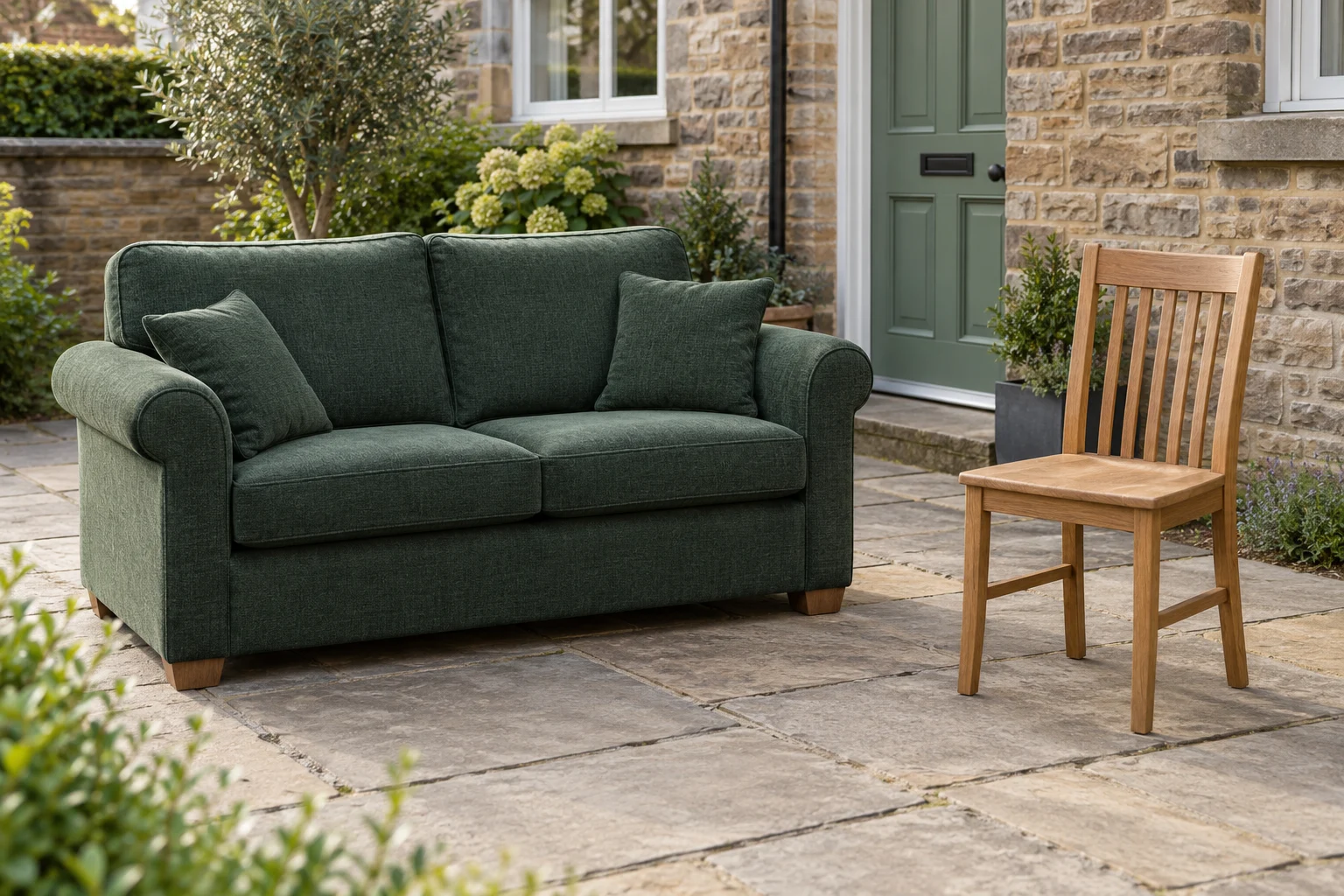
An office chair and a household chair may look alike in an image. Their appearance can help identify the object, but the waste-producing activity helps identify the service route. The same principle applies to cardboard, garden material and electrical equipment. A description should cover both the object and the reason it became waste, rather than relying on a photograph alone.
Council household services have their own local acceptance rules. Check the relevant council’s current page for the actual address and enquiry; a national definition does not promise that a specific local service will accept every item. The Leeds bulky-waste options guide and Bradford collection guide explain why eligibility, presentation and item limits should be checked separately.
Do not extrapolate a neighbour’s successful collection to your business clearance. Their furniture may have been household waste, their access may have differed and the council’s offer may have changed. Use the published conditions and, where needed, an explicit response to your own description. Save that response beside the inventory so that the person preparing the load works from the same acceptance decision as the person who booked it.
Separate service selection from material assessment
After recording origin, review each material group. Ordinary furniture, electrical items, upholstered seating, liquids and unknown building material should not be forced through one generic price field. The provider may accept some groups through a routine route and refer others for specialist review. That is a useful outcome: it turns an uncertain whole-site enquiry into a collection with a defined scope.
Use three statuses in the working inventory: ready to quote, awaiting information and excluded from this collection. Ready to quote means you have a description and permission, not that a collection is already authorised or paid. Awaiting information means there is a specific unresolved question. Excluded means the provider should not load it under the current agreement, even if it is stored beside approved material.
For containers, report what can be read safely from intact labels, approximate quantity and visible condition. Do not open, mix or test substances to complete the form. Our paint and solvent disposal guide shows how an inventory can support review without pretending to classify a chemical from a photograph. A commercial origin does not make an unknown container suitable for general commercial waste.
Give the quotation a clear boundary
A useful quotation refers to a numbered inventory, a collection address and the agreed access conditions. Ask whether its total includes the accepted material groups, labour, transport, applicable taxes and any stated extras. If an item is awaiting review, the quotation should say whether it is excluded or provisionally allowed subject to a specified decision. “All rubbish” is too loose when the job contains several origins or streams.
Explain the carrying route as well as the roadside location. Floors, stairs, lifts, locked gates and the distance from storage to vehicle can change the work involved. A postcode can support location planning but cannot reveal a narrow corridor or restricted service yard. Include a safe access photograph where useful, and identify any loading restrictions you already know rather than assuming the driver can resolve them on arrival.
The quote-comparison guide offers a method for comparing like-for-like scopes. Use it after origin and acceptance are established. A lower total for a household-only load is not directly comparable with a commercial quotation covering different items, documentation and labour. Ask each provider to explain the same inventory and assumptions before deciding which offer gives the best value.
Know which records belong to which decision
Keep the original enquiry, acceptance response and final collection record linked by the job reference. They answer different questions: what you requested, what the provider agreed to collect and what actually left. If an item is left behind, update the final record rather than leaving the full original list marked as completed. This helps a business reconcile the work and helps a household understand the remaining task.
Business handovers can require waste transfer information; ordinary domestic occupiers dealing with their own household waste have a different duty-of-care position. The code’s household section does not impose the wider waste-transfer-note requirement on those occupiers. Do not therefore copy a business form into every household booking and call it compulsory. Conversely, a payment receipt alone should not be assumed to contain all required information for a business transfer.
For business collections, read our transfer-note guide and agree the appropriate records with the provider. For carrier checks, use the England registration guide. Registration, a service quotation and a receiving site’s authorisation are separate matters. Keep their details distinct rather than treating a logo or an online checkout as proof of the whole disposal route.
A worked mixed-origin enquiry
Imagine a fictional small retailer closing a home storage room. The room contains household shelving, stock packaging, a work printer and two unidentified maintenance containers. Start with separate entries. The family approves the shelving for removal. The business manager identifies the packaging’s origin. The printer remains on hold until ownership and data decisions are complete. The containers are described without opening them.
The enquiry explains that the address is residential but the collection includes business material. The provider is asked to confirm which entries can share a visit, which need another route and which records will accompany the commercial transfer. The household shelving is not used as a reason to relabel everything. Nor is the presence of packaging used to assume that the provider will accept every object in the room.
Before collection, the approved entries are marked on the inventory and the held items are visibly kept out of scope. The person meeting the team has a copy of the agreement. If someone adds another printer or a bag from the garage, that change is referred for acceptance and any price adjustment before loading. The process remains manageable because uncertainty was recorded early rather than discovered in a packed vehicle.
Questions worth resolving before you choose the route
Who produced each group of waste, and through what activity? Who owns or controls the items? Is the work a resident’s clearance, a business clearance, a contractor’s removal or a mixture? Has a council or provider accepted this particular description? These questions usually clarify more than debating whether a single object looks domestic or commercial. Put short answers at the top of your enquiry.
Then ask about the practical service: which groups are accepted, whether a separate specialist assessment is needed, who will do the carrying and what happens if the actual load differs. Request a clear process for changes rather than relying on verbal assurances that “everything will be fine”. This is especially useful where an agent books remotely and another person opens the property on the day.
Finally, check that the approval and payment stages refer to the same scope. An enquiry should not become a paid booking while an important acceptance question is unresolved. A proposed online journey can make these questions easier to answer, but a form cannot remove the need for a lawful route or sound human review. Keep the material description truthful even when a different menu choice appears faster.
Prepare a request that can be reviewed quickly
If several people are coordinating a job, nominate one person to reconcile their descriptions before submitting the request. A homeowner may describe an item by the room it came from while a contractor describes the same item by the work that produced it. Keep both accounts until the origin is clear. Do not delete the commercial explanation just to make a household form accept the enquiry.
A useful first message could say: “Collection from a residential address; entries one to three are our household belongings, entries four and five arose from paid renovation work, and entry six is held pending ownership confirmation.” This is an illustrative description, not a classification decision. It lets the reviewer ask focused questions about specific entries instead of repeatedly asking whether the entire property is a home or a business.
Use one concise opening statement, a numbered inventory, a few relevant photographs and a description of access. Include the material’s origin and any items held for assessment. This gives a reviewer enough structure to identify the correct journey without requiring you to know every technical term. It also helps reduce repeated calls asking for information that could have been captured once.
For a larger business job, the West Yorkshire manager’s guide develops the operational specification. For a household clearance, the household planning guide helps compare reuse, council and private options. Choose the companion that fits the activity you have described, while keeping any mixed-origin entries visible.
You can register with YWG and save your collection details, photos and access information in a private listing draft. Specialist material still needs separate assessment and approval. YWG is opening soon. Live collection booking and payment are not yet available. Preparing an accurate request now is still valuable. It gives whichever suitable provider you select a stronger basis for a collection that matches your actual needs.
Sources & editorial note
- GOV.UK: business waste responsibilities and commercial origin
- GOV.UK: household waste and tradesperson-produced waste
- Waste duty-of-care code: domestic occupiers and clearance origin
Original origin-first worksheet and fictional mixed home-office enquiry. Current England official sources read on 3 October 2026; household note distinction and landlord-vacated-premises scope checked in code section 5. No item-specific legal classification, fabricated prices, carrier credentials, operating coverage or active booking claim.
AI-assisted original editorial content, checked against the sources above. No professional qualification or firsthand YWS job experience is claimed.