
Paint and solvent disposal: describe containers before requesting a quote
Prepare a paint and solvent disposal enquiry in West Yorkshire with known product information, container counts, household or business origin and an acceptance review.
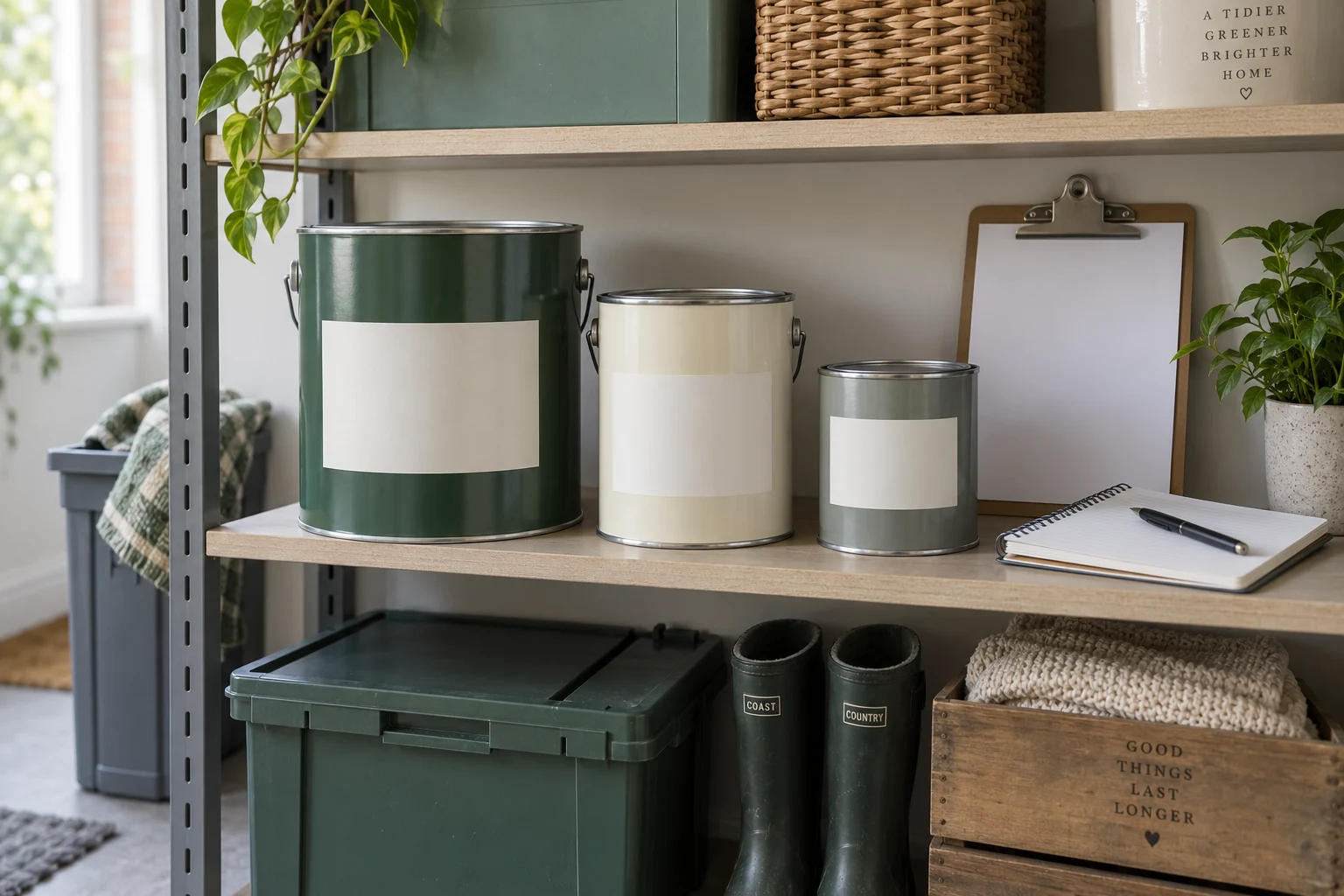
Leftover decorating materials are easy to overlook until a room, garage or workshop needs clearing. Several tins may look alike while containing quite different products. One may have a readable paint label; another may be an unidentified liquid left by a previous occupier. A request to remove “a few paint tins” can therefore leave the receiving service without the information it needs to decide whether it can accept the job.
For households and businesses in West Yorkshire, the sensible starting point is an accurate enquiry about the containers and their known contents. Describe what you know without opening, smelling or testing an unfamiliar product. Keep uncertainty visible rather than replacing it with a convenient label. This guide concerns preparation for an acceptance decision; it does not provide chemical treatment, mixing, drying, transport or disposal instructions.
Begin with the product information you already have
Look for information available without disturbing the container: an existing photograph, purchase record, product information or label that is already safely visible. Record the product name as written rather than simplifying everything into “paint”. A provider may need to distinguish a known decorating product from a solvent, adhesive, coating or other material before deciding what questions to ask next.
If you cannot establish the contents, write “unknown contents”. That is more useful than guessing from the colour of the tin or the location where it was found. A container left beside decorating equipment is not proof that it holds the same product. Equally, a familiar brand label may not establish what remains inside if you know the container was reused. Explain that uncertainty in the request.
Do not touch, move or open a questionable container to complete an inventory. If it appears damaged, leaking or otherwise concerning, seek suitable specialist advice about the situation before treating it as an ordinary collection. An online form should allow a request to be held for review. It should not encourage someone to investigate a substance merely because a required field has been left blank.
The important distinction is between reporting available information and making a chemical assessment. You can tell a provider that a visible label says a particular product name. That does not mean you have established the waste classification, suitability for transport or safe receiving route. Keep those decisions with the appropriate people using the relevant information, rather than turning a household description into an unsupported technical conclusion.
Count containers separately from their remaining contents
Give the number of containers and their labelled capacities where known. Then distinguish that capacity from the amount believed to remain. A container marked with a volume does not necessarily contain that volume now. If the remaining quantity is unknown, say so. Do not open or disturb the contents to obtain a more precise figure for a quote.
Use separate entries when products differ. For example, a known paint product and a container described as a solvent should not be merged into one approximate total simply because they occupy the same shelf. The provider needs to understand the range of materials, not only how much physical space the containers appear to take up. An honest list can support a targeted follow-up question.
Avoid a price comparison based solely on container count. Two enquiries with the same number of tins can concern different products, conditions and receiving arrangements. A provider's estimate should be tied to the identified scope and any unresolved assessment. No regional average or YWS specialist tariff is established by this guide. Ask what information is needed before the service can offer a suitable collection price.
Keep a simple enquiry reference beside the inventory and update it when a provider clarifies a question. This reference is an organisational aid, not an official waste code. It lets you connect the product description, acceptance response and proposed appointment without losing the qualification that some information is estimated or still unknown.
Establish whether the waste comes from household or business activity
Describe how the material arose. Leftover products from your own household decorating and waste produced through a business activity can need different arrangements. The location where you find them is not the only relevant fact. A business product stored at a residential address does not automatically become eligible for a household disposal service because the address looks domestic.
If a contractor or other business produced the waste, clarify responsibility with them rather than silently adding it to a household request. The government household disposal guidance distinguishes waste arising from a tradesperson's construction or renovation work. Give the receiving service an accurate account of the origin and ask which route applies to the particular enquiry.
For business waste, the government hazardous-waste overview describes role-specific responsibilities and lists solvents among hazardous examples. That does not establish that every paint product has the same classification. It also does not justify selecting a non-hazardous category because the packaging looks familiar. Obtain the relevant assessment for the actual material and the business activity involved.
Keep the household and business questions separate in your notes. A council page describing a household paint route does not confirm acceptance of commercial stock, solvents or unidentified chemicals. A private service also needs to say what it accepts. When origin is unclear, disclose that uncertainty before arranging a destination rather than hoping nobody asks when the containers arrive.
Read a council paint entry as a specific acceptance route
The Kirklees material guide directs empty or partly full household paint cans to household recycling-centre routes and says they do not belong in its ordinary household bins. Check the relevant access conditions and current site instructions before making plans. This paint entry is not a general permission to bring any chemical product or problematic container to any site.
Leeds' Meanwood site page lists paint separately from household/DIY chemicals, which have a stated quantity limit. Do not take the chemical-list limit as a universal all-paint collection rule. Ask the chosen site about the actual product, quantity and condition where acceptance is unclear, and check the current eligibility requirements for that route.
The useful question is narrower than “does the tip take paint?” Identify the site and service, then ask whether it accepts these particular containers under these circumstances. A material appearing on a council page does not settle every concern about its contents, origin or condition. Nor does acceptance at a receiving site establish that a household can safely load and transport the items itself.
If you need a collection rather than a site visit, request that arrangement explicitly. A disposal route and a home collection are different services. The government household hazardous-disposal finder helps residents identify their council route for enquiries. It does not promise that every council offers the same collection, price or acceptance conditions across Leeds, Bradford, Kirklees, Calderdale and Wakefield.
Photograph available information without investigating contents
An overview photograph can show the known container count and the setting in which the collection is being requested. A second image may show a label that is already safely visible. Explain if the image does not identify every container or if something relevant is out of view. Do not shift a questionable container, remove a lid or expose a substance to make the photograph more informative.
Read the image alongside the written inventory. A blank or damaged label should remain an unanswered question, not a prompt for software to guess. Our photo quotation guide explains how photographs support scope assessment. For paint and solvent enquiries, the extra boundary is that an image cannot prove chemical identity, remaining quantity or appropriate classification.
Keep personal information out of the images where possible. A useful collection photograph does not need to show household paperwork, financial records or unrelated business documents. If a provider needs product information, share that relevant information through the agreed channel. Avoid sending an entire room's private contents merely because you are trying to make the enquiry look complete.
Ask for acceptance before arranging a handover
Use a short sequence: describe the known material, disclose uncertainty, obtain the provider's assessment, and confirm the actual acceptance arrangement. An enquiry received by a business is not the same as a load accepted for collection. A quoted transport charge is also not necessarily evidence that every container has been reviewed. Ask what the provider has agreed to take and what remains outside scope.
Request clarification when a reply says only “paint accepted”. Does that reply address the products in your inventory, their origin, quantity and known condition? If a solvent or unidentified item is also listed, ask for an explicit response about it. Do not assume the broad phrase covers everything. Keeping the provider's answer linked to the inventory makes later changes easier to recognise.
If further specialist assessment is needed, leave that part of the request pending. Do not replace the uncertainty with a generic category simply to reach the payment screen. A reliable booking journey should support an assessment hold and explain the next step. The correct result of an enquiry can be a request for more information rather than an immediate appointment or automated fixed price.
Keep reuse enquiries separate from waste acceptance
Known usable paint may have a potential reuse recipient, but acceptance needs to be agreed for the exact product and condition. A group accepting leftover decorating paint does not automatically accept solvents, unidentified liquids or every old tin. Ask what information it needs before arranging any handover. Do not describe a product as usable merely because you would prefer to avoid disposal.
Tell the recipient what is known and what is uncertain. An old label, a missing purchase record or doubts about the contents should not disappear from the description once you switch from a waste enquiry to a donation enquiry. The practical objective is an informed agreement. It is not to transfer a difficult decision to someone else by presenting uncertain material as a useful gift.
If reuse is not accepted, retain the accurate inventory for a suitable waste enquiry. Do not interpret refusal as evidence that a product has a particular hazardous classification; the recipient may have other acceptance conditions. Equally, a willingness to consider reuse does not establish that every legal or technical question is resolved. Keep the assessment appropriate to the actual product and receiving arrangement.
Review the provider and the complete quotation
For a private waste collection, establish who is taking responsibility for the job and check the appropriate official identity route. Our carrier-check guide explains how to match the proposed collection business to its record. Registration checking is a separate task from confirming that this particular material can be accepted through the proposed specialist route.
Ask the provider to describe the service included in the price. Does it cover the agreed containers at the stated location, the necessary assessment and the confirmed collection arrangement? What changes would require a revised offer or a different service? Our quote comparison guide helps you compare scopes without treating every headline amount as the same job.
Avoid treating a planning estimate or a price published for another waste stream as an approved hazardous-waste tariff. The complexity lies in the actual material and arrangement, not just the postcode or number of containers. No claimed average market price or YWS acceptance commitment is supplied here. A suitable offer needs to reflect the provider's review and the information available about the enquiry.
Plan access without changing the containers yourself
Describe where the items are located and the access constraints: the floor, steps, gate, shared entrance or other relevant feature. Say if you cannot prepare a handover yourself. Agree what the service will do and what it requires before collection. This guide gives no repackaging, loading, chemical storage or transport procedure; those questions need appropriate advice for the particular material and situation.
If conditions change, tell the provider before the appointment. A newly noticed damage concern or an unidentified additional container can alter the scope. Do not assume that an earlier acceptance response automatically covers the changed request. Keep the update connected to the inventory and wait for confirmation of the suitable next step rather than relying on the arrival team to make an unexpected decision.
For a business, assign a contact who can explain the inventory and the agreed scope. Keep relevant documents connected to the enquiry; our business records guide explains the distinction between booked work and actual transfer information. Specialist documentation requirements need their own review and should not be replaced by an ordinary payment receipt.
A fictional decorating-clearance enquiry
Imagine a household clearing materials left after several decorating projects. This is a fictional example, not an actual YWS job. It has two containers with product information already available, plus a third whose contents cannot be identified. Its first request says “three paint tins”. The written inventory then makes the important distinction: two known products and one unresolved item, with remaining quantities described only as estimates.
The provider answers the known-product enquiry and asks for appropriate specialist review of the unresolved item. The household does not open it, guess from appearance or quietly add it to the accepted scope. The final collection arrangement identifies what has been accepted and what remains pending. A photograph supports that description but does not make the chemical assessment on anybody's behalf.
The lesson is an accurate acceptance decision rather than a fictional saving. The household knows which request is ready to proceed and which question still needs an answer. That clarity is useful even when it means the job takes longer to arrange. An instant quote would be less helpful if it concealed a material uncertainty that only becomes apparent at handover.
Keep the final agreement connected to the inventory
When a provider replies about only part of the enquiry, record that boundary beside its answer. An entry might refer to the two known-product descriptions while leaving the unidentified container pending. Keep the unanswered question visible when confirming a date, so a household helper or colleague does not read a partial response as approval of the entire shelf. If another provider is assessing the remaining entry, use the same enquiry reference to avoid duplicate commitments for the accepted items. This is an administrative comparison of descriptions and responses; it does not require touching containers or making a technical judgement about their contents.
Use a simple status beside each inventory entry: awaiting information, awaiting assessment, accepted under stated conditions, or outside this collection. These are suggested enquiry statuses, not chemical classifications. Write the date of the provider's response and link it to the specific entry. This makes it easier for another household member or employee to understand why two similar-looking containers may have different next steps.
Review that status before changing an appointment or passing the enquiry to a different provider. Acceptance given by one service should not be copied across as though another service has agreed it. Preserve the underlying product information and questions, but obtain the new provider's own answer. A clear handover of the enquiry can save repeated explanations while keeping responsibility for the actual acceptance decision with the service that will perform it.
Before the appointment, check the accepted container list, known contents, quantity qualifications, origin, access and contact details. Retain the provider's confirmation and raise any discrepancy before handover. After the service, retain the information supplied about completion and the appropriate records. Do not claim a particular recycling, reuse or treatment outcome merely because the containers have left the property.
You can register with YWG and save your collection details, photos and access information in a private listing draft. Specialist material still needs separate assessment and approval. Specialist coverage, authorisations and collection arrangements require separate confirmation. Specialist bookings and payments are not currently available through YWG. Start with the information already available, preserve uncertainty honestly, and proceed only when a suitable service has confirmed the actual collection arrangement.
Sources & editorial note
- GOV.UK household waste and tradesperson-origin distinction
- GOV.UK business hazardous waste overview
- Kirklees Council material-specific paint guidance
- Leeds Council Meanwood site accepted items
- GOV.UK household hazardous council finder
Original current government/council sources checked3October2026. Household paint entries not extended to solvents, unknown containers or business waste; chemical and paint list entries distinguished. Original inventory/status workflow and fictional household example, not technical classification or qualified legal review. No chemical handling/treatment/transport instructions, tariffs, licence claims or actual YWS acceptance.
AI-assisted original editorial content, checked against the sources above. No professional qualification or firsthand YWS job experience is claimed.