Huddersfield furniture disposal: choosing a suitable collection route
Compare furniture disposal routes in Huddersfield using acceptance, safe transport, indoor loading and timing. Includes Kirklees checks and local reuse information.

Furniture disposal in Huddersfield is easier to organise when you choose a route around the item and your practical constraints. A usable bedside cabinet may suit a reuse enquiry. A worn sofa may need an assessed waste collection. A large wardrobe upstairs presents a loading problem even before you consider price. Those differences matter more than simply finding a service labelled “furniture removal”.
For Huddersfield households, Kirklees Council publishes local collection and recycling-centre arrangements, while reuse organisations provide another starting point for suitable belongings. The right choice depends on acceptance, safe transport, loading and confirmed timing. A website listing an option does not mean it can accept your particular item or meet your deadline, so keep those questions visible until they are answered.
This guide uses four practical tests to compare the routes: whether the item is accepted, whether you can safely get it to the handover point, whether the timing works and whether the full arrangement is clear. It includes original decision examples and a moving-day coordination method. Current council information is linked and dated; no private-provider coverage or Yorkshire Waste Solutions operating tariff is assumed.
Apply four tests before choosing a route
First, ask about acceptance. Identify the furniture, describe its condition and say whether it is upholstered, electrical or accompanied by other material. A potential recipient or collector needs that information to assess the request. Keep acceptance provisional until the relevant organisation confirms it. An item that appears suitable to you may still require further assessment.
Second, ask about the handover. Where does the item stand, and where must it be when the service begins? A drop-off route requires an appropriate transport plan; an outdoor collection requires suitable presentation; an indoor loading service needs its own access assessment. Do not assume a low collection figure includes carrying furniture through a property.
Third, ask about timing. The date you would like, a date displayed while browsing and a confirmed collection arrangement are different things. If you are moving or receiving replacement furniture, coordinate those events around actual confirmations. Where the collection may happen in stages, keep space and access available for the outstanding work.
Finally, ask about the complete arrangement. Understand the accepted inventory, price where applicable, responsibilities, exclusions and contact process. These tests help you compare routes without pretending every offer is equivalent. An option can be suitable for one item and unsuitable for another in the same home.
Check Kirklees' current collection information
On 3 October 2026, Kirklees Council's bulky household waste page lists £11.66 for a standard bulky item and £31.80 for a sofa, recliner, armchair or mattress. It advertises a maximum of six in those categories, with different limits for other categories. The service is domestic, not commercial. Items must be presented outside; crews do not enter homes or outbuildings. Upholstered seating and other items can have different collection days. Check the full current terms, item categories and any eligibility-based concession before booking. These are council figures, not YWS rates.
Read that information against the furniture you actually have. Do not choose a category just because its price is lower, or treat two physically different objects as equivalent because both fit the word “chair”. If the description is unclear, obtain an answer from the council before submitting the order. A correctly understood category is more useful than an apparently precise calculation built on a guess.
Keep the actual confirmation as the reference for dates and presentation. A research note is useful while comparing options, but it cannot replace the instructions for a booked collection. If someone else is helping with the preparation, share the relevant confirmation rather than an old screenshot of the general service page.
Explore local reuse while the item is still suitable
For usable furniture, investigate whether another person or organisation can accept it before treating it as waste. Revive Reuse's own location information lists its Huddersfield shop at 8 Upperhead Row, HD1 2JN. Contact the organisation about the intended item, acceptance and practical handover before travelling. A shop address is not a promise of home collection or permission to leave an unsolicited donation outside.
Prepare an honest condition description. State dimensions where known and supply photographs that show the whole item and relevant damage. If you cannot safely reach a particular angle, explain that rather than moving a heavy object just for the picture. Do not hide defects in the hope that the recipient will take the furniture once it has arrived.
Ask what is needed for a decision, then wait for the answer. Some enquiries may require more information or a different route. Keep a fallback plan, especially where a move creates a deadline. You do not need to assume rejection, but you should avoid organising the rest of the clear-out around a donation that has not been accepted.
Separate ownership from suitability. A usable table may still belong to a landlord, housemate or relative. Obtain the appropriate permission before arranging a handover. If you are disposing of your own belongings from a shared property, make those boundaries clear to anyone collecting. A reuse opportunity does not give you authority to remove another person's furniture.
Consider recycling-centre access before planning a trip
Kirklees' household recycling-centre page explains that a vehicle permit is required and describes donation facilities for suitable small furniture alongside household recycling and disposal routes. Check its current site information, accepted materials and vehicle arrangements before deciding to transport an item yourself. Do not assume every vehicle or type of waste qualifies because the item came from a home.
Make transport a real decision rather than an afterthought. Consider whether the furniture can be handled safely, whether the available vehicle is suitable and whether the receiving route has confirmed acceptance. This guide does not provide loading or lifting instructions. If you cannot carry out the journey safely, ask about an appropriate collection option instead of forcing the item into an unsuitable plan.
Account for the whole trip in your personal comparison: preparation, travel, unloading arrangements and the time needed. Do not attach an invented monetary saving to your own labour. A self-delivery route can be practical for one household and impractical for another, even where the receiving service has the same terms. Your capability is part of the choice.
Keep different material descriptions clear if you take several items. A furniture enquiry should not quietly expand into a vehicle full of unknown mixed material. Check the relevant guidance for everything you intend to deliver, and resolve unfamiliar or specialist material separately. A permit or an accepted furniture item does not establish acceptance of the entire load.
Decide whether outdoor presentation is realistic
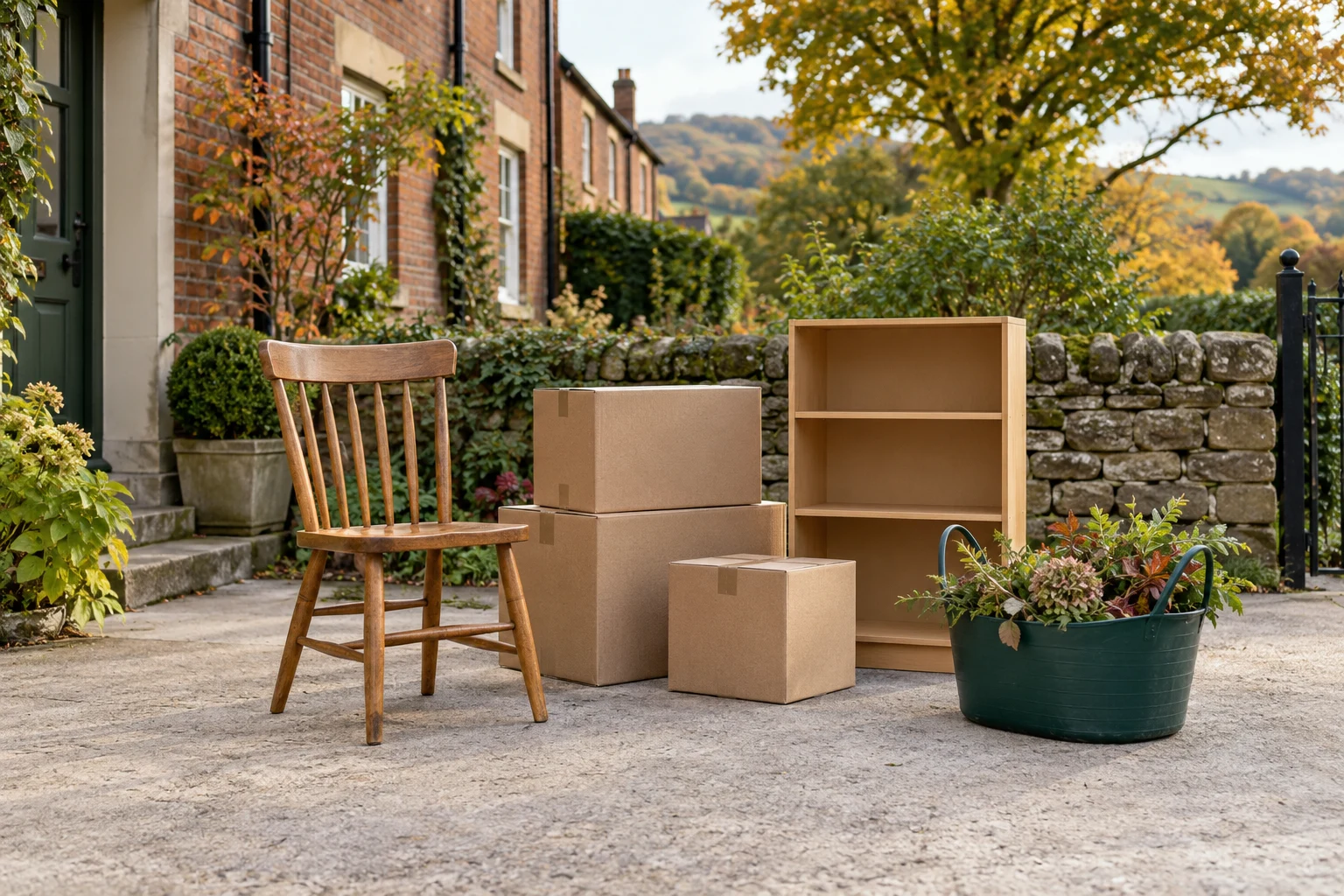
Look at where the furniture stands now and the proposed handover point. If the route requires items to be ready outside, ask whether you can safely meet that requirement. A first-floor bedroom, a narrow staircase or a heavy item can make the preparation a separate task. Resolve it before booking rather than assuming friends or family will be able to help at the last moment.
If you need indoor loading, state it clearly in a private enquiry. Describe the floor, stairs, lift where relevant and the route towards the vehicle. Ask the business what further assessment is required and whether the requested work is included in its offer. Do not interpret a photograph of the item as confirmation that access has been assessed.
Keep the preparation plan realistic for the people involved. If a service's requirements are outside your capability, explain the difficulty and seek a suitable alternative or support arrangement. Avoid dismantling furniture or attempting strenuous handling simply to reach a cheaper category. The appropriate provider should assess the work that actually needs doing.
For an outdoor point, establish the exact agreed position and any permissions required. A shared passage or courtyard may be controlled by more than one person. Keep it accessible and follow the booked service's instructions. Do not use a pavement or public space as an assumed holding area while waiting for someone to accept the item.
Treat upholstered seating as a specific enquiry
A sofa and a plain wooden table should be identifiable as separate items in your description. Upholstery affects the questions the receiving operator needs to consider. Do not rely on the general phrase “old furniture” when requesting a collection. State the seating type and whether other objects form part of the proposed job.
The Environment Agency's upholstered domestic seating guidance addresses waste seating that may contain persistent organic pollutants, or POPs, and the appropriate segregation and destruction arrangements. It is not a household test for identifying chemical content. Leave the furniture intact and let a suitable operator assess the route. Do not cut foam or covers to support an enquiry.
When a service gives separate arrangements for different items, record them individually. Do not treat the first completed collection as proof that the whole order has finished. This is especially useful when arranging a clear room for a replacement delivery: the room may still contain another booked item or require access for its later collection.
Reuse and waste disposal also require different assessments. A hopeful reuse enquiry does not establish that an item can legally or practically be passed on, while the presence of upholstery alone does not prove every usable item is waste. Explain its condition and circumstances to the relevant recipient or operator and follow the appropriate acceptance process.
Build a handover timeline around confirmations
Use a simple timeline with four entries: decisions complete, route accepted, collection or delivery confirmed, and work finished. Assign a person to each outstanding decision if several people are involved. This is an original coordination method, not an official council timetable. It is useful because a furniture change often includes several organisations whose work cannot be assumed to happen together.
Start with hard constraints, such as a property handover or an agreed replacement delivery. Tell potential providers about those constraints while allowing them to confirm their actual availability. Work backwards from the confirmed arrangements to identify what must be decided first. Leave unresolved enquiries visibly pending instead of marking them as bookings.
If there are several accepted routes, keep separate dates and inventories for each. A recipient collecting a table should not be presented with the sofa assigned to a different operator. Likewise, the person opening the property should know which items are expected to leave on that visit. Clear handover notes reduce the need for decisions under time pressure.
Plan for changes without inventing guarantees. Ask the booked organisation about its rescheduling and contact process, and keep a practical way to communicate altered access or inventory. If one event moves, review the rest of the timeline. The aim is to maintain a workable plan, not to predict that every collection will happen without disruption.
A fictional tenant's room change
Imagine a fictional tenant in Huddersfield who wants to remove an owned bedside cabinet and a worn chair before moving. The furnished room also contains a landlord's desk. The first useful decision is ownership: the desk must remain unless an authorised agreement says otherwise. Photographing the whole room without that explanation could produce a misleading enquiry.
The tenant asks a reuse organisation about the cabinet, supplying its dimensions and an honest condition description. The arrangement remains pending until accepted. For the chair, the tenant describes its construction and present position and asks an appropriate service to assess it. The moving date is stated as a constraint, not treated as a confirmed collection slot.
Access then determines the practical choice. The tenant cannot safely carry the furniture down the stairs. A route requiring outdoor presentation is therefore incomplete without a suitable preparation arrangement. The tenant requests an indoor-loading assessment rather than assuming that the cheapest collection description includes the work. This is a fictional example, not a real customer's result or a claim about any provider's availability.
The lesson is specific: ownership, acceptance and loading must all be resolved for the route to work. Finding a recipient for one item does not settle the other, and a preferred move date does not resolve either enquiry. A short handover timeline makes those remaining dependencies visible before anyone commits to an unsuitable arrangement.
Compare prices only after comparing the work
Once a private provider has enough information, request a written offer covering the intended items and actual loading conditions. Ask which materials are accepted, which are excluded, how quantity uncertainty is assessed and what the total payable amount represents. Do not use a council figure as a private market average; the services may include different work and have different eligibility conditions.
Our quote comparison guide gives a practical method for matching scopes and totals. Apply it to your confirmed inventory rather than comparing the lowest figures displayed on several websites. If one offer depends on you moving everything outside and another includes indoor loading, identify that difference before making the decision.
Keep your own constraints alongside the price. A lower figure may still be unsuitable if the required preparation cannot be done safely or the confirmed timing does not fit. Conversely, an option with fewer included tasks may be appropriate if those tasks are already safely arranged. Value depends on the complete plan, not an assumption that every household needs the same level of service.
Check the collector's identity and the appropriate registration before engaging a private waste business. GOV.UK's household disposal guidance directs household customers to the official upper-tier carrier register. Clarify who performs the job and who issues the invoice if more than one business is involved. A booking interface does not establish that status by itself.
Prepare an enquiry that supports a real assessment
Combine a dated item list, useful photographs, known dimensions and access notes. Explain whether the request is final or whether decisions remain outstanding. Say what loading work you need and what you can confirm about the material. If something is unknown, mark it plainly rather than converting an assumption into a fact for the sake of an instant answer.
Our photo enquiry guide explains overview, detail and access pictures, with a simple manifest and privacy checks. Use photographs to support the written scope, not replace it. A picture cannot establish weight, hidden contents or chemical composition, and a provider may reasonably need further information or a visit.
If the item count or its location changes, update the enquiry before proceeding. Keep the final offer and inventory together so both parties refer to the same arrangement. For a broader household project, the West Yorkshire planning guide helps organise the whole clear-out while you confirm individual routes.
Keep commercial clearances on the appropriate route
Furniture from a workplace or a commercially managed clearance needs its own service assessment. Do not assume a domestic option applies because the object resembles home furniture or the address is residential. Explain the activity that produced the waste and the organisation responsible. Where eligibility is uncertain, resolve it before making a household booking.
Our commercial manager's guide provides a separate site brief and handover process. It covers asset decisions, access approvals and collection records. Use that framework for business work, while checking the actual provider's accepted materials and operating arrangements. This article does not confirm collector availability in Huddersfield. Check eligible offers and accepted collection details when bookings open.
Finish with a confirmed route for each item
Before the furniture leaves, check that the accepted inventory, access and handover dates still match the real situation. Make retained items clear and ensure the person coordinating the collection has the relevant instructions. If part of the plan remains pending, keep it separate from the confirmed work and obtain the missing answer rather than hoping it will be resolved on arrival.
You can register with YWG and save collection details, photos and access information in a private listing draft. YWG is opening soon. Live collection booking and payment are not yet available. An actual Huddersfield job needs confirmed coverage, acceptance, loading, timing and price from the relevant operating service before you proceed.
Sources & editorial note
- Kirklees Council: bulky household waste, prices and presentation
- Kirklees Council: household recycling-centre access and reuse
- Revive Reuse: organisation and shop locations
- Environment Agency: waste upholstered domestic seating containing POPs
- GOV.UK: household disposal and private carrier checks
Kirklees and Revive original pages checked on 3 October 2026. Environment Agency and household carrier sources checked in the current research series. Short council figures are not YWS tariffs or market averages. Original four-test decision method, handover timeline and fictional tenant example provide distinct utility; no guaranteed reuse acceptance, collection availability or DIY handling advice.
AI-assisted original editorial content, checked against the sources above. No professional qualification or firsthand YWS job experience is claimed.