Bed frame and headboard disposal: count the parts before booking
Count bed frames, slats, headboards and mattresses accurately, distinguish council booking rules and agree the actual preparation and collection task.
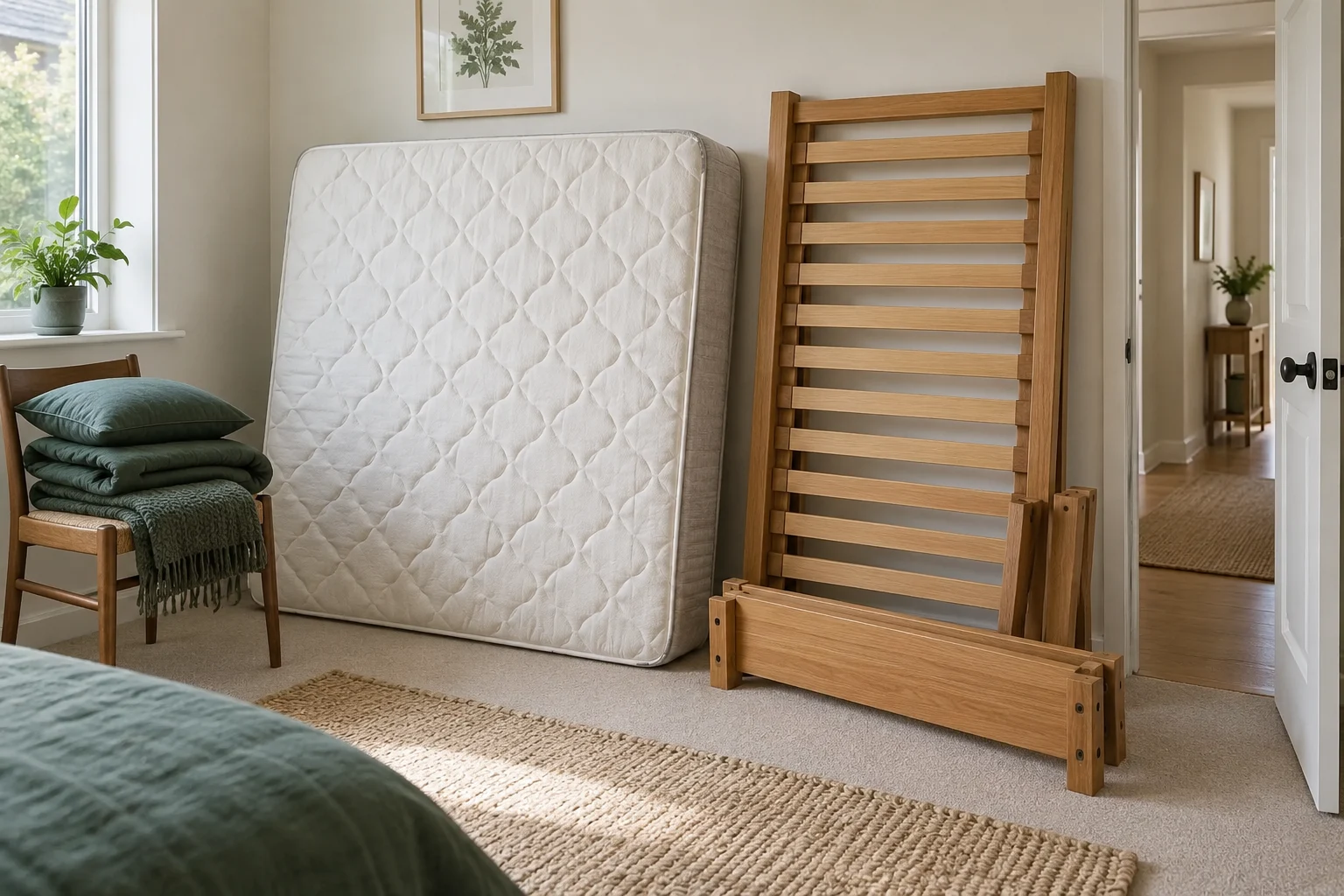
Booking removal of a bed starts with understanding what the word bed includes. A frame, slats, mattress, headboard and separate base can be treated differently by a collection service. One piece of household furniture may become several booking entries, especially where preparation changes its state. Count the actual material and confirm the chosen route’s rules before accepting a price or appointment.
For households in Leeds, Bradford, Wakefield, Huddersfield and Halifax, an accurate bed-parts inventory avoids two common problems: leaving components out of the enquiry and assuming that every provider uses the same item count. This guide offers an original reconciliation method from bedroom inventory to collection record. It is a planning aid, not a dismantling procedure or a promise that a particular service accepts every kind of bed.
Leeds’ unwanted-items collection page gives a specific example of a bed counted as frame, slats, mattress and headboard. Kirklees’ household bulky page lists furniture including frames and mattresses with its own service conditions. Read the actual offer rather than assuming that one council’s example is a universal industry rule.
Start with the furniture as it currently exists
Describe the bed type in plain language and record whether it remains assembled. A wooden frame, upholstered base, storage bed, bunk arrangement and adjustable bed can involve different components and movement tasks. The phrase double bed helps explain size but does not communicate the construction. Include any known model information without guessing what is concealed inside an upholstered or mechanical section.
List what the household wants removed and what it is keeping. A mattress may move to another room while the frame leaves, or the headboard may be retained for a replacement. Do not assume that a photograph showing all those pieces means they are all included. Give retained items a clear status so the collection provider does not make that decision at the doorway.
Record separate bedding and nearby furniture independently. Pillows, a topper, loose bedding and bedside cabinets should not disappear into a generic bed entry. The mattress guide develops the bedding inventory questions. A clear initial list helps the reviewer assess each group rather than applying one label to everything visible in the bedroom.
Create a parts list without beginning dismantling
Identify visible parts and any information already available from the product or previous assembly record. Note the frame, slats, headboard, base sections and other recognisable units. You do not need to dismantle the bed just to produce this first enquiry. State what cannot be verified without further work, especially where the arrangement has mechanisms, concealed attachments or uncertain condition.
Use references that remain useful if the furniture later changes state. For example, frame, headboard and mattress references can follow the job through photographs and accepted scope. A loose-fitting bag can be described separately if it forms part of the agreed load. Avoid an unsupported claim that every screw or bracket has been accounted for if the furniture is still assembled and has not been assessed.
The parts list is not a technical waste classification. It explains the objects and task so the provider can confirm what information it needs. Do not assign a waste code because another bed looked similar online. A provider should assess the actual material and route, while the household supplies an honest account of what it can observe.
Separate object count from booking count
Your household inventory and the service’s booking count may not be identical. You might describe one bed frame with its slats, while a council requires those as separate items. A private provider may quote the complete accepted scope using another measure. Record both descriptions rather than changing the inventory to conceal components that the booking system counts separately.
Ask the chosen service how it wants the actual parts entered. Do slats form one described group under that offer? Is the headboard separate? How are two base sections treated? These are questions for the provider, not universal answers supplied by this guide. Keep its explanation beside the enquiry so another family member can prepare the load against the same assumptions.
Do not use bundling as a way to bypass an item limit. A group placed together may still require several entries. If the load exceeds the offer’s limit, ask about a suitable arrangement rather than omitting parts. The relevant decision is whether the service accepts the whole described job, including its quantity and preparation state.
Understand the Leeds example in its own context
The current Leeds page says parts of dismantled objects are counted individually and illustrates a bed with four items: frame, slats, mattress and headboard. That is useful evidence when checking a Leeds household booking. It does not establish that every bed has exactly those parts or that additional bases, drawers or another mattress are automatically included in the same four entries.
Read that example alongside the offer’s eligibility, preparation and presentation conditions. An item count alone does not answer whether the service can take your load from its current position. Our Leeds bulky-waste guide explains the wider household enquiry. Use the current official page to settle the applicable conditions for your address and circumstances.
If preparation instructions are unclear for your bed type, ask before acting. A general reference to dismantled items is not a technical method for handling an unstable bunk frame or mechanical base. Describe the concern and ask about the appropriate route. This guide deliberately does not turn a council booking example into instructions for dismantling furniture.
Check other routes without importing that count
Kirklees and other councils have their own material lists and booking arrangements. A household in Huddersfield should check the current Kirklees offer rather than using the Leeds four-item example as its booking rule. Likewise, the presence of frames and mattresses on a list should be read with the rest of the service conditions, not treated as acceptance of every bed construction.
For Bradford, Wakefield or Calderdale, identify the relevant authority and inspect its current page for the actual collection enquiry. Ask about the parts where needed. Do not create a West Yorkshire average count from several different systems. Your quote comparison should follow the load and responsibility at the property, while each candidate route explains its own way of recording it.
If a private provider proposes a whole-bed quote, ask which components are included and what preparation state it assumes. “Bed removal” can describe room removal of assembled furniture or collection of prepared parts at another point. Those offers should not be compared as equivalent until their carrying, preparation and material scope are clear.
Keep mattress and frame decisions separate
Record the mattress’s type, approximate size, condition and location independently from the frame. Explain whether it is included, retained or awaiting another route. A provider quoting only frame disposal should not be assumed to accept the mattress without discussion. The same applies to a topper or additional bedding stored in another room.
A mattress can be unsuitable for a proposed reuse route while the frame is still a possible reusable asset. Conversely, a damaged frame may need waste collection while a household retains its mattress. Make the decision for each item explicit. Do not let the convenience of one visit turn distinct acceptance questions into an assumed all-or-nothing arrangement.
If there is an infestation concern, unusual contamination or another condition affecting handling, disclose it before an ordinary collection is agreed. Do not undertake a treatment solely to fit an enquiry category. Keep the relevant item pending for appropriate advice and acceptance. Photographs can support the description but do not establish that an item is suitable for every service.
Do not confuse a sofa bed with an ordinary bed frame
A sofa bed includes seating as well as a sleeping function. Describe that construction and any mechanism rather than selecting a bed-frame category to avoid a seating question. The Environment Agency’s upholstered domestic seating guidance includes waste sofa beds among relevant seating. Its separate mattress scope wording does not reclassify the whole upholstered sofa bed as an ordinary mattress.
Keep uncertain upholstered components identifiable and ask the provider to confirm the appropriate route. Do not cut covers, remove foam or mix them with other furniture to make a smaller general load. This article offers an inventory process, not a chemical identification or treatment method. A collection enquiry should preserve the distinction that an appropriate assessment needs.
For an upholstered headboard or base, describe the item accurately and seek the relevant assessment rather than applying the sofa-bed rule automatically. Exclusion from the particular domestic-seating guide does not prove another item pollutant-free. The useful first action remains the same: a clear description, intact condition where practicable and an acceptance decision from the appropriate provider.
Make storage and mechanisms explicit
Tell the reviewer if the bed has storage drawers, a lifting base, powered adjustment or another mechanism. Explain its current state and any known damage without attempting a repair for collection. The movement task may differ from that of a simple frame. A hidden mechanism should not be omitted just because the overall photograph looks like an ordinary bed.
Clarify what remains inside storage sections and who will resolve those contents. A furniture collection should not be assumed to include sorting personal belongings or disposal of everything beneath the mattress. Keep the contents decision separate, then describe the empty or otherwise agreed collection state accurately. Do not claim it is already empty if preparation remains to be done.
Ask what information is needed about powered equipment or internal components. Do not disconnect, force or dismantle them merely to complete a routine form. If another competent task is required before collection, record the dependency and responsible person. The quote should distinguish that task from collection rather than silently placing it on the household.
Map where each part is and how it can leave
Record room, floor, stairs and lift arrangements for the items included. If parts are stored in different places, list those locations. A headboard in a bedroom and frame panels in a garage can require a different carrying scope from a single prepared group beside an agreed entrance. The provider needs the current positions, not the original assembly location alone.
Include the route to the collection point and any shared-area restrictions. Ask the appropriate building contact about permissions and timing where necessary. Do not assume an agency key or household access to a courtyard grants unrestricted loading rights. A workable arrangement includes the vehicle’s arrival point and who can resolve a gate or door problem.
Use measurements where they can be obtained safely, marking approximate values. Do not assume that fitting through one doorway proves the whole movement task is possible. Turns, landings and other objects can matter. The provider should assess its method from the supplied information, while the household records uncertainty instead of moving awkward parts just to improve the enquiry.
Agree preparation responsibility in writing
State whether the bed remains assembled and ask who is responsible for any preparation required by the selected route. A service that collects prepared material externally differs from one including agreed room removal. Avoid treating an attractive headline quote as covering dismantling when the provider has not accepted that task. Both the item state and labour responsibility should appear in the confirmation.
If another person undertakes approved preparation, arrange a factual handover of the resulting components, condition and location. Do not rely on “bed dismantled” as the final inventory. Ask for a count and suitable current photograph where useful. Any unexpected damage or additional part should be reported before the collection scope is treated as unchanged.
Keep preparation within an appropriate agreed plan. This article does not supply tool instructions, a lifting method or a procedure for a damaged mechanism. Where there is uncertainty, obtain the relevant assessment before work. A booking form should support that pause rather than make the household guess how to turn a complex object into an apparently standard collection.
Take component photographs that remain intelligible
Photograph the original arrangement and the current accepted state when needed, clearly distinguishing which is current. Match images to the item references and written count. A collection of panels can be difficult to interpret without an overview and scale. The reviewer should not have to infer the complete load from a close-up of one slat or an unlabelled fitting.
Include access views separately and avoid private documents or possessions in the frame. The photography guide offers a useful structure. Do not move an unstable part to stage a tidier image. Explain if a section cannot be examined safely and ask what information would help the provider assess it.
If a part is retained or donated after the initial photograph, update the count and scope. Keep a note that identifies which entry changed. A photograph showing more material than the final load can still be useful history, but it should not be the only evidence of what is now included. The written instruction should be recognisable to the person meeting the collection team.
Compare totals for the same complete scope
Send each suitable provider the same component list, condition and access description. Ask what its total includes, how it measures the accepted load and whether applicable taxes or other charges are included. Clarify preparation and carrying responsibilities. A frame-only external collection is not the same scope as removing a frame, mattress and headboard from an upstairs room.
Use the quote-comparison guide to identify those differences before judging price. No national or West Yorkshire bed-removal tariff is invented here. The useful comparison is based on the actual furniture, accepted parts, site and work required, not the number of times a provider uses the word bed in its offer.
Agree a change process for added parts or a different presentation state. If the final inventory exceeds the quotation assumption, ask for acceptance and any price adjustment before loading. A small component should not be silently included merely because it came from the same original object. Clear scope protects the household from surprises and gives the provider a sound basis for the visit.
Check the route as well as the item count
For private household waste removal, carry out appropriate checks using GOV.UK’s household guidance. The carrier-check guide distinguishes transport registration from receiving-site permission. A correctly counted booking is still incomplete if the actual material and proposed route have not been accepted.
Keep confirmation, item list and collection reference together. If someone else meets the team, provide that version and explain what remains excluded. A helper who has access to the home may not have authority to approve an added charge or another item’s removal. Make that role clear before the appointment rather than expecting the crew to negotiate it on arrival.
After attendance, record what left and what remained. An invoice or receipt can help the household reconcile the service, but do not invent a recycling or destruction outcome from the fact that the material was loaded. State the completed task accurately and identify the next decision for any part that still needs another route.
Use a final count reconciliation
Start with the enquiry inventory, subtract items genuinely retained or handed over elsewhere and add any accepted discoveries. Record the resulting collection list and the provider’s confirmation. This is an original household control method, not a weighing procedure or statutory form. It is useful because bed components can move between rooms and change state while other moving work continues.
Check the count with the person preparing the collection point. They should recognise the entries and know which description applies to grouped components. If their list differs, resolve it before the visit. A mismatch should trigger a clarification, not a hurried decision to hide another piece in the load or assume the crew will take it without review.
Keep the final count separate from the original household object count. Both can be true: one bed replaced, several collection entries agreed. Recording them separately prevents confusion when checking a council limit or reviewing a private invoice. The service’s count method should be visible without rewriting the history of what the household actually owned.
A fictional frame-and-headboard request
Imagine a household replacing a bed while keeping its mattress. The initial room photograph shows everything assembled, but the written inventory identifies the frame, slats and headboard for the enquiry and marks the mattress retained. The household asks the chosen service how those components should be counted and what state it must present them in. No universal three-item rule is assumed.
After preparation through an appropriate arrangement, an additional separate base section is identified. The coordinator updates the list and asks for acceptance before the visit. The provider’s response and any commercial change are recorded. The person meeting the team has the final version, so the retained mattress is not removed merely because it appeared in the first photograph.
Prepare your booking information
Collect the current parts list, condition description, suitable photos and route information. Add preparation responsibility, the chosen service’s count method and anything held for assessment. You can register with YWG and save collection details, photos and access information in a private listing draft. YWG is opening soon. Live collection booking and payment are not yet available.
Counting carefully is a small task with practical value. It gives the council or provider a more accurate load, gives the household a clearer price comparison and helps the collection contact recognise what may leave. The goal is an agreed complete scope for the actual bed parts, rather than forcing every construction into one familiar furniture label.
Sources & editorial note
- Leeds unwanted items collection
- Kirklees bulky household waste
- Environment Agency: upholstered domestic seating containing POPs
- GOV.UK household waste responsibilities
Current primary sources read on 3 October 2026. Original household-parts versus service-count reconciliation. Leeds four-part example scoped to its current service, not every bed or provider. Sofa-bed seating scope preserved and mattress exclusion not a pollutant-free finding. No dismantling, powered-mechanism or lifting instructions, invented prices or service claims.
AI-assisted original editorial content, checked against the sources above. No professional qualification or firsthand YWS job experience is claimed.