
Business bin sizes: choose capacity from your waste audit
Choose business bin capacity from an honest waste audit: separate volume from weight, check access and compare container sizes with collection frequency.
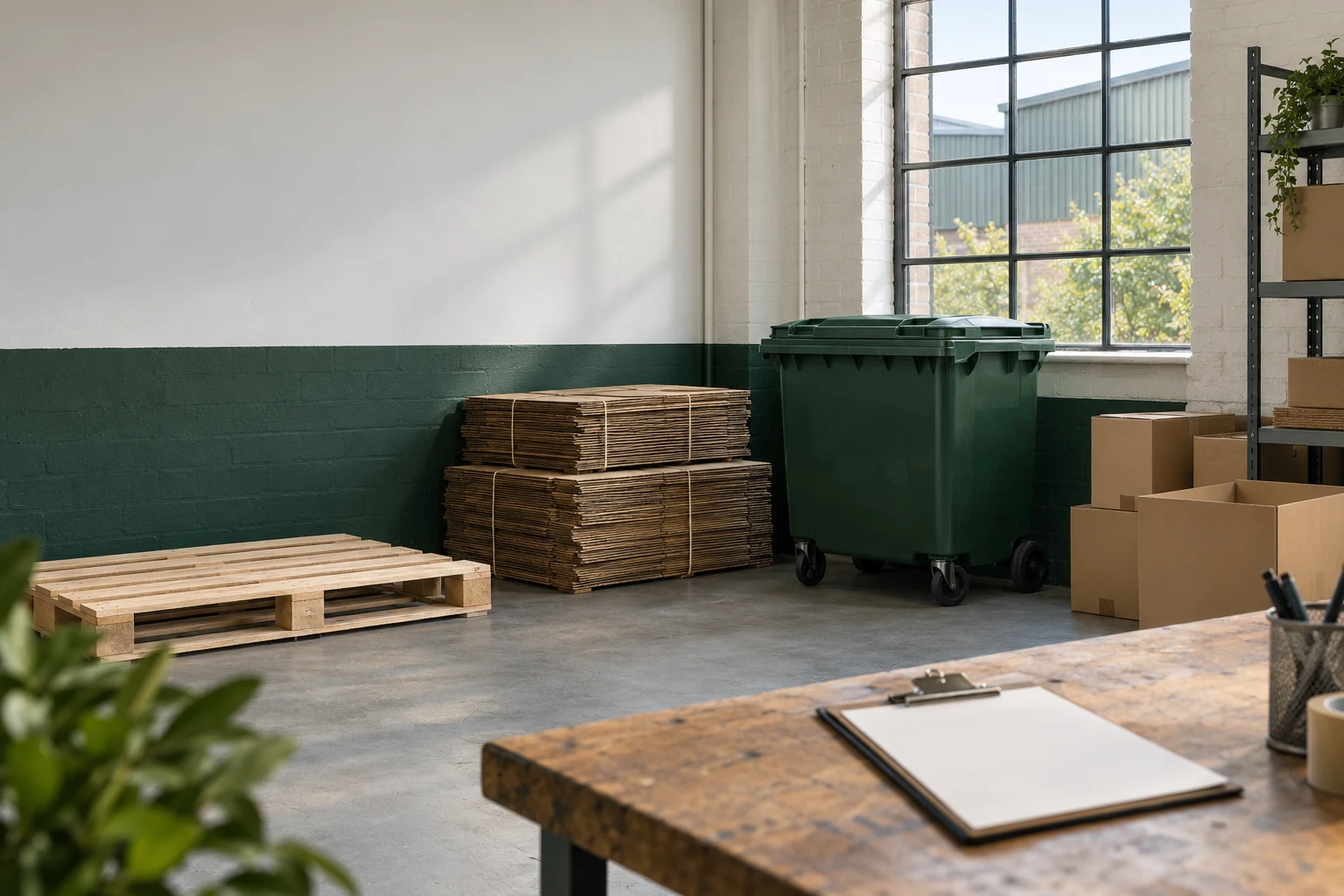
The right business bin is the one that suits the material, the space and the amount produced between collections. Start with a short waste audit before choosing a capacity. A container that looks generous when empty may be unsuitable for heavy material, awkward to move through a narrow route or too small during the busiest part of the week. Equally, a larger bin may occupy valuable space without solving an irregular collection schedule.
For a shop, office, café or warehouse in West Yorkshire, useful sizing information comes from your own operating pattern. Record each stream separately, observe what happens between actual collections and ask the provider to confirm its container specifications and service limits. This guide offers a practical method for that enquiry. It does not provide supplier-specific dimensions, load limits or lift prices.
The GOV.UK workplace recycling guidance says workplaces can choose container sizes and collection frequency according to the volume they produce, within the relevant separation arrangements. That leaves room to design a sensible service for your premises. It does not mean every material can share one large bin or that a stated litre capacity is a permitted weight.
Begin with streams and collection intervals
List the waste streams your business actually generates before considering container sizes. Everyday packaging, food, residual waste and a one-off furniture clearance need different questions. Ask the provider what it accepts in each proposed service and how that material must be presented. Keep electrical equipment, chemicals and uncertain items out of the ordinary bin calculation until their routes are confirmed.
Then write down the interval between collections for each stream. A weekly timetable can still contain a longer gap around a holiday or closure. The busiest delivery day may occur just after the bin is emptied. Look at the period that the container has to cover, rather than dividing a monthly total by the number of calendar days and assuming production is even.
Choose an observation period that includes a representative operating cycle. For some businesses that could be a normal trading week; for others it needs to include deliveries, events or seasonal variation. Record why you think the period is representative. If the premises are newly opened, describe the observations as an early estimate and agree when the service will be reviewed.
Do not mix historic and proposed operations without explaining the difference. A café adding evening service should not size its future collection solely from daytime waste. A warehouse changing its packaging process may reduce one stream while increasing another. Note the change and discuss it with the provider instead of hiding uncertainty inside a single confident capacity figure.
The business collection planning guide helps define the overall service. A sizing audit adds the detail needed to compare container and frequency options. It should support a conversation, not pretend to replace the provider's assessment of the site and material.
Keep an audit that people can complete during normal work
Use a simple log for each stream with the date, observation point, approximate fill, last collection and any unusual event. Name one person to bring the records together. Several employees can contribute observations, but everyone should use the same method. Otherwise “half full” may mean something different on every shift.
Observe containers from a safe position without climbing into them, opening uncertain bags or compacting material by hand. This is a planning exercise, not a waste-sorting procedure. Where you cannot assess contents safely, record the uncertainty and ask the provider about an appropriate audit method. Do not create an exposure or lifting task simply to obtain a more precise number.
Use consistent descriptive bands if precise measurement is unavailable: low, roughly half, mostly full or unable to close as intended. Photographs of the outside arrangement and visible fill can help explain a pattern, provided they do not expose sensitive information. State that these are visual estimates. They are not weighbridge measurements or proof of a load's weight.
Record the time of day. A photograph taken immediately after collection answers a different question from one taken after a large delivery. The useful comparison follows the same points in the cycle. Add notes such as “delivery received this morning” or “closed yesterday” so a reviewer understands why two otherwise similar days look different.
Include missed or changed collections in the log. A full container following a missed visit does not automatically show that the normal capacity is inadequate. Conversely, repeated overflow before a reliably completed collection may indicate that the service needs review. Distinguishing these causes avoids buying more capacity to compensate for a problem that lies elsewhere.
Distinguish volume from weight and presentation
Litres describe volume. They do not tell you the safe or accepted weight for a particular container and collection vehicle. Ask the provider for the relevant load limit and any material-specific restrictions. A bin full of lightweight packaging and the same bin containing dense material can create very different collection conditions.
The physical shape of the waste also affects useful capacity. Empty boxes left assembled occupy space differently from boxes presented according to an agreed flattening arrangement. Oversized items may obstruct the lid or be outside the service entirely. Describe the material as it will be presented, and do not assume that pushing it down makes a rejected load acceptable.
Check the provider's rule for lids, loose material, bagging and anything placed beside a container. A full bin should not become an invitation to leave extra bags nearby unless the service expressly accepts that presentation. Ask how additional waste is quoted or collected. Keep the answer with the audit so staff know when to request a change.
For dense or specialist materials, stop using a general office-bin analogy. Rubble, liquids, industrial residues and other unusual streams may need a different container or service entirely. This guide does not assign a classification or handling method to those materials. The useful information is their identity, origin, quantity evidence and the provider's confirmed acceptance.
If your estimate is based on bags, record the actual bag dimensions or stated capacity and how full they normally are. “Ten bags” is not a standard volume measurement. Do not compare a provider's small sacks with your large packaging bags as if they were equivalent. A photograph with a non-sensitive scale reference can support the description, without turning the estimate into a guaranteed load calculation.
Measure the space the container must use
Ask for the proposed container's external dimensions, not only its capacity. Check the footprint, height and the space needed to open the lid in the planned location. Include the route between that position and the collection vehicle. Door widths, turns, slopes and surface condition can matter as much as the size of the bin store itself.
Tell the provider whether the area is shared and who controls access. A managing agent may allocate a specific position or restrict collection times. Do not assume unused space belongs to your business. Agree the location with the relevant party before ordering equipment that will affect neighbouring occupiers, circulation or deliveries.
Keep exits, access routes and other required clear areas available. Ask the provider to assess the proposed collection arrangement where needed. A photograph of a narrow passage should prompt an access discussion, not a promise that employees will drag a loaded container through it. The service needs to work for the actual building and the people responsible for presenting it.
Check the practical details of the lid and opening. Can the intended users place ordinary items inside without awkward manoeuvres? Is the opening appropriate for the material and provider's instructions? Does the chosen location expose the container to unauthorised use? These questions can identify a design problem that a larger litre figure would not solve.
Save a basic sketch or photograph with the measured clearances and agreed position. Mark observations as measurements and unknown dimensions as questions. Send this to the provider with the audit. The quotation photography guide explains how to show access clearly without including unnecessary private information.
Compare more capacity with a different frequency
Once the material and space are understood, ask the provider to compare practical service options. The choice might involve a different container size, more containers, a changed collection frequency or an agreed extra collection during a known peak. The available options depend on that supplier's equipment, route and acceptance requirements.
Compare the complete service rather than the advertised price of one lift. Ask about container supply, rental if applicable, the quoted collection frequency, weight allowances, excess charges, contamination terms and changes. Confirm the treatment of VAT in the quote. Do not assume every supplier uses the same charging model or that a low lift price covers all other elements.
Consider the storage period as well as the occupied floor area. A less frequent collection may leave material on site longer. For a stream that causes odour or attracts pests, simply choosing a larger container may not be an appropriate answer. Ask the provider about the material and your storage conditions; agree a suitable frequency rather than calculating on volume alone.
Where demand has a predictable peak, describe its timing and duration. A one-off stock clearance does not necessarily justify a permanent increase for the whole year. Equally, a recurring busy season should not surprise the provider every time. Ask when additional capacity must be requested and how availability and charges will be confirmed.
The quote comparison guide provides a way to record inclusions and exclusions. Use the same audited material and access assumptions for each supplier. If one proposal depends on a different presentation method or collection position, show that difference beside the price instead of treating the offers as identical.
A fictional capacity calculation with visible assumptions
Imagine an office estimates that its accepted dry-recycling stream occupies about 360 litres between ordinary collections. The figure comes from consistent visual observations, so it remains an estimate. For discussion, the manager adds an illustrative 25 per cent planning allowance: 360 multiplied by 1.25 gives 450 litres of estimated space. That arithmetic is a planning example, not an industry standard or a supplier recommendation.
The manager asks a provider what real container and frequency options could suit the estimated requirement. They do not order a particular model on the assumption that every nominal capacity is fully usable. The provider still needs to confirm accepted materials, presentation, dimensions, weight limits, access and available service. A volume allowance cannot answer those questions.
The audit then reveals that a monthly delivery temporarily adds much more packaging than an ordinary week. The manager records that event separately and asks about an agreed extra service. Averaging the event across a month would have concealed the space required on the day the delivery arrives. The peak and the ordinary cycle deserve separate attention.
Finally, the manager compares the first few completed collections with the estimate. If the container is repeatedly much emptier than expected, the audit method or proposed service may need adjustment. If it fills sooner, the manager checks whether material, presentation, working hours or collection timing changed. The example has no claimed saving; it shows how to make the assumptions inspectable.
Turn the audit into a supplier brief
Send the provider a concise summary rather than an unexplained spreadsheet. Start with the type of business, site address, operating pattern and streams requested. Then include the observation period, ordinary fill pattern, known peaks, current collection frequency and any missed visits that affected the record. Say clearly where figures are estimated.
Add the proposed location and access information. Identify the person who can agree the container position and the person who will present it for collection. If the premises are shared, explain the boundaries of your responsibility. A provider cannot assess a service properly if it assumes unrestricted access to an area controlled by somebody else.
Ask for the proposed equipment specifications and service terms in a form you can retain. Match each container to its accepted stream and collection arrangement. Avoid approving a bundle of unspecified “bins” where the business has several different needs. A later query should be traceable to the particular container and service.
Agree how the service will be reviewed after it starts. Choose a point that captures a meaningful operating cycle and identify what evidence will inform the review. Keep the conversation focused on observations: fill before collection, access problems, contamination reports and actual changes in production. The first estimate can be useful without being treated as permanent truth.
Separate a capacity problem from a collection problem
Before increasing the service, compare the observations with the actual collection history. A bin that was not emptied because the gate remained locked presents a different issue from one that fills too quickly after every successful visit. In the first case, more capacity may only delay the next access failure. In the second, a review of volume, presentation or frequency may be appropriate.
Use three questions in the review. Was the scheduled collection completed? Was the material accepted and presented as agreed? Did the business operate as expected during the interval? Answer each using the log and provider's information. If an answer is unknown, keep it unknown until checked rather than deciding that the container must be too small.
Ask staff about practical obstacles without expecting them to diagnose the commercial arrangement. They may know that deliveries block the bin store on a particular morning or that cardboard arrives after the last collection before a closure. Those observations can help the manager choose a better question for the provider. They are more useful than a general instruction to “fit more in”.
Where a larger container is proposed, check the access route again using the new dimensions. A model that fits inside the store may not pass through the gate or leave room for another stream. Compare the whole proposed layout, including lids and circulation, rather than replacing one rectangle on a floor plan with another.
If the service uses several containers, give them unambiguous local references. The audit might distinguish a front-store recycling bin from a rear-yard residual bin even when both look similar. This helps a collection query identify the right container and prevents a change intended for one stream being applied to the entire account.
Retain the review decision with the observations that supported it. Write what changes, when it starts and what will be checked afterwards. A short decision note lets the next manager understand why the business chose its capacity without repeating the entire enquiry. It also prevents an old estimate from becoming an unquestioned permanent specification.
Keep the record useful as the business changes
Repeat a short audit when the business changes its opening hours, staffing, packaging, premises or activities. A new tenant sharing the bin store can also change how the arrangement works. Record the reason for the review so future managers understand why a capacity or frequency decision was made.
Keep collection records with the service specification. The business waste transfer-note guide explains the relevant non-hazardous documentation. Those records do not replace a capacity audit, but they help establish what collection actually occurred when you investigate an unexpected fill level or invoice.
For a new enquiry, gather the material list, estimated volume pattern, access details and provider questions first. You can register with YWG and save collection details, photos and access information in a private listing draft. YWG is opening soon. Live collection booking and payment are not yet available. The goal of your audit is a service that fits the business's real waste and site, with assumptions that can be checked and revised.
Sources & editorial note
Original observational audit. Fictional360litres x1.25=450litres is not industry allowance or product recommendation. No supplier dimensions, lift limits or prices invented. Primary sources reviewed 3 October 2026. YWG is opening soon. Live collection booking and payment are not yet available.
AI-assisted original editorial content, checked against the sources above. No professional qualification or firsthand YWS job experience is claimed.