
Restaurant waste collections: separating food and dry recyclables
Specify restaurant waste collection around preparation, service and closing, with food and packaging routes, collector instructions and a practical shift handover.
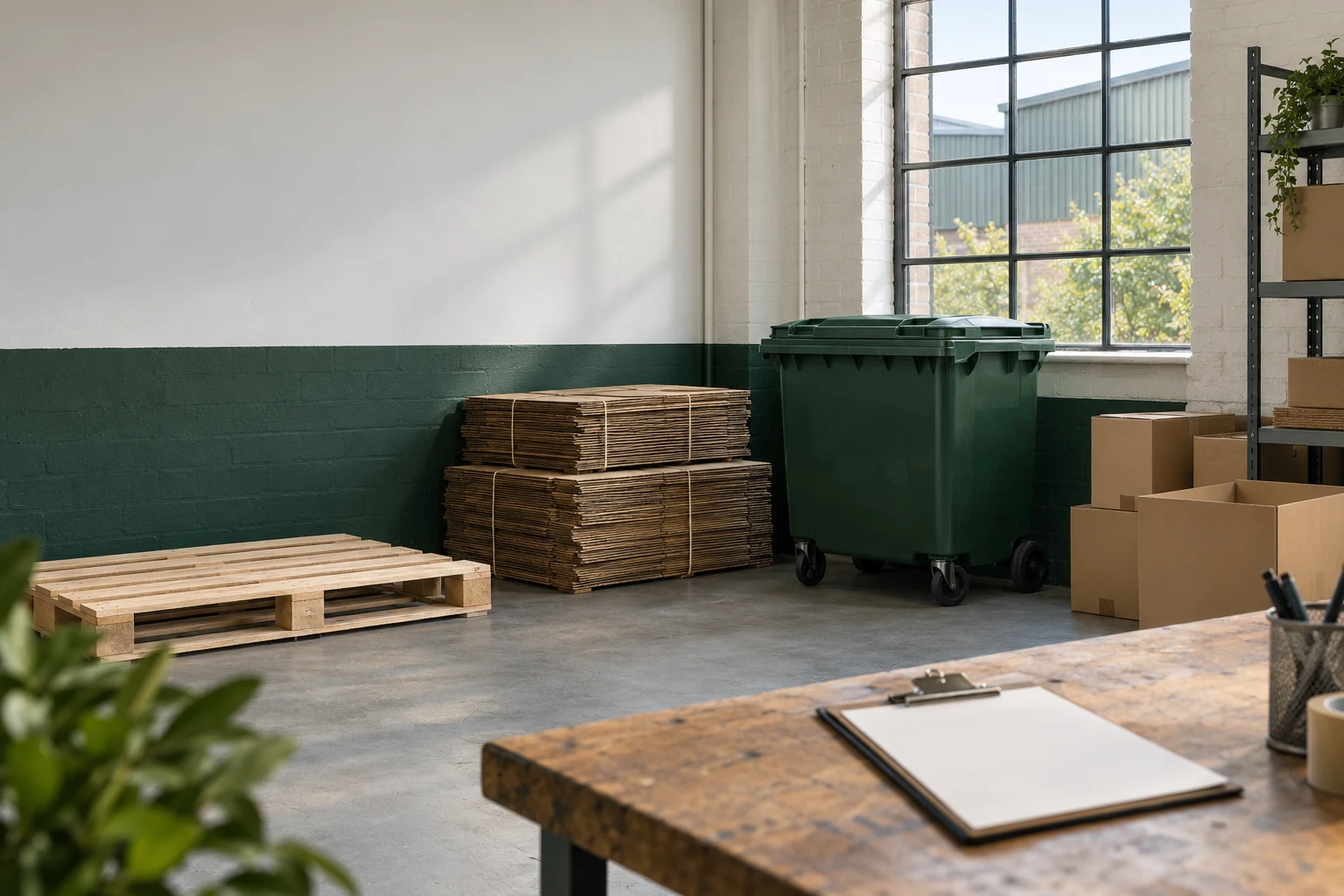
A restaurant waste arrangement has to work through preparation, service and closing. Food waste, delivery packaging and customer containers appear at different times and in different areas. A plan that looks straightforward before opening can become awkward during a busy shift if staff have to carry every item across the kitchen or guess whether unfamiliar packaging belongs with recycling.
For a restaurant in Leeds, Bradford, Wakefield, Huddersfield or Halifax, begin with the movement of material through the site. Map where it arises, how it reaches internal containers, where it is stored and how the collector accesses it. This guide offers an original shift-handover method built around those stages. It is practical planning information, not a food-safety assessment, an official form or a guarantee that a particular collector accepts your material.
GOV.UK’s England workplace recycling guidance includes restaurants and other hospitality workplaces. Its current requirements and micro-firm timetable should be checked against your business’s position. Use the legal guidance to establish scope, then obtain actual acceptance instructions from the collector. YWG is opening soon. Its listing journey is designed for individual jobs; a recurring restaurant service needs a separately agreed collection arrangement.
Map three moments in the working day
Start with preparation, service and closing as separate observations. During preparation, look at identifiable food offcuts and delivery packaging. During service, consider what comes back from tables and what appears at the takeaway counter. At closing, follow how internal containers are emptied and moved to storage. Observe normal work without asking staff to open unsafe waste or interrupt tasks in a way that creates another problem.
Write each observation with a place and a time. “Cardboard arrives by the rear door before lunch” is more useful than “lots of packaging”. “Food container fills during evening service” indicates a different capacity issue from a container that remains nearly empty but is in the wrong position. These descriptions help the collector discuss frequency and containers while helping the restaurant improve the internal route.
Use an ordinary shift and a busy shift. A weekday lunch observation alone may miss the restaurant’s weekend pattern. Record unusual events separately so that an exceptional party does not become the assumed volume of every service. Your plan needs an everyday arrangement and a way to request extra capacity when activity changes, rather than a guessed average that fits neither situation well.
Confirm the main streams and their collection route
The England guidance separates food waste, dry recyclables and residual waste before collection. Paper and card have their own collection requirement, subject to a collector’s permitted written co-collection assessment. Ask how the proposed service implements those streams at your restaurant. Do not decide that limited space makes any mixture acceptable or assume a “mixed recycling” label settles the arrangement.
For each accepted stream, obtain a short material list, preparation instructions and container specification. Confirm whether material should be loose or presented in an agreed bag, and how internal containers feed into the external collection point. Those instructions should be consistent across the kitchen, dining area and cleaning routine. A restaurant may use more than one suitable provider, but staff still need a coherent site plan.
Make a separate exception list for items outside routine collection. Kitchen equipment, broken crockery, unusual packaging and maintenance materials should be assessed against the applicable acceptance instructions rather than placed in the nearest recycling bin. Keep the question attached to a material description. The provider should be able to see what needs clarification without interpreting “restaurant waste” as an unlimited promise to accept everything on the premises.
Distinguish food material from food packaging
Food waste and its packaging should not be treated as the same stream. The workplace guidance says packaging labelled compostable or biodegradable does not belong in ordinary food-waste recycling; a dedicated route may be needed, otherwise it is treated as non-recyclable. Food caddy liners are addressed separately in that guidance. Ask the collector for the applicable instructions instead of extending one rule to every labelled product.
Create a packaging reference for products the restaurant buys regularly. Record a plain description and the collector’s answer about the route, rather than expecting a new employee to interpret unfamiliar symbols during service. If a supplier changes a container or takeaway product, check whether the acceptance instruction still applies. A purchasing change can affect waste presentation even when the menu and quantity of meals stay the same.
Where an item is uncertain, hold the decision for the designated manager and provider rather than making an unsupported recyclable claim. A tray that looks like plastic may not fit the agreed dry-material list, and a visibly food-soiled box may need different handling from clean delivery cardboard. Give staff a practical way to ask, then update the reference so the same question does not recur on every shift.
Give food waste an internal route staff can use
Identify the places where suitable food material is produced and agree point-of-use containers with the people working there. Subject to the site’s arrangements, a container should be accessible without blocking the task or creating an awkward repeated journey. The aim is a route that works during actual preparation and service, rather than a layout selected only because it looks tidy in an empty kitchen.
Record who empties each internal container, at what operational stage and into which final container. A vague instruction to “take the bins out” can leave separated material combined at the last step. Give closing staff the same stream names used at the point of disposal. If the cleaning team has a separate process, walk through it with them and resolve any mismatch before relying on the arrangement.
Do not use the food-waste plan as a substitute for the restaurant’s hygiene and safety procedures. Coordinate the container route with the appropriate site responsibilities and obtain suitable advice for those matters. This article focuses on collection specification. It does not prescribe a universal container-cleaning method, storage temperature or food-safety timetable that may be unsuitable for your operation.
Plan dry packaging around deliveries
Delivery packaging often arrives in a short period while staff are preparing for service. Identify where accepted paper and card can be stored dry, how staff move it and who checks available capacity. Confirm the collector’s preparation instructions before adopting a method. Do not assume that every protective packing material can be added because it arrived inside a cardboard delivery box.
Separate the packaging inventory into materials you can identify and materials needing confirmation. A photograph can show quantity and condition without being used as a chemical or technical identification test. Describe a mixed delivery group honestly. If the provider only accepts part of it, record another route for the remainder rather than disguising the whole group as clean card.
If the restaurant has a cramped rear area, discuss collection frequency and a workable presentation point. A larger container may not fit through the gate or leave enough space for other agreed streams. Measure the access route and confirm dimensions before ordering. Our business waste manager’s guide explains how access and storage belong in the service specification alongside material type.
Include customer and takeaway areas
Walk through the customer journey from ordering to leaving. Public bins should reflect the material customers actually handle, with clear instructions and relevant examples. A takeaway counter may produce different waste from a seated dining area. Use observations rather than copying the arrangement of a neighbouring restaurant whose menu, packaging and opening pattern differ.
Check what happens after customers use those containers. The person emptying them needs an agreed route to the corresponding collection stream. A clear public label does not solve a closing routine that combines the contents. Include front-of-house staff in the walkthrough so that responsibility does not stop at the kitchen door or remain an assumption held only by the manager.
Review customer instructions when the business introduces new packaging or changes the dining layout. A drinks station or seasonal takeaway offer can create a new point where waste arises. Update the reference list and container positions as needed. The useful goal is a route customers can understand quickly and staff can manage consistently, rather than a long notice that no one has time to interpret.
Keep used cooking oil instructions separate
The current workplace guidance discusses cooking fats, oils and grease, including small amounts with food waste or a used-oil collection according to the collector’s instructions. It says cooking oil must not go down the drain. Obtain a clear explanation of the arrangement offered for your actual quantities and material, rather than assuming that a routine food container is suitable for every container of oil.
Record the oil arrangement as a separate line in the site plan if it uses a separate provider, container or collection pattern. Identify who checks capacity, who requests the visit and which acceptance instructions apply. This keeps the closing team from making an improvised decision because they cannot find the oil-service contact while another collection is taking place.
Do not transfer, mix or otherwise handle uncertain material merely to make it fit a collection description. If a container’s contents or condition are unclear, record the uncertainty and request appropriate assessment. The operational advantage comes from knowing the route in advance. It does not come from forcing a difficult material through the easiest menu choice on an enquiry form.
Write a shift handover that covers waste
Distinguish an immediate capacity observation from a long-term service-change request. Closing staff may report that a particular container is nearly full; the manager should record what happens before the next visit and discuss an appropriate response. A permanent increase in frequency should follow the operating evidence and provider agreement, rather than becoming the automatic answer to one exceptional booking or party.
Add a short note when a new packaging item first appears in service. Identify the product, its supplier description and the person seeking collection instructions. Until the answer is available, staff should follow the agreed uncertainty process rather than each choosing a different stream. Once resolved, put the answer into the packaging reference and handover. This closes the information gap between purchasing a product and expecting every shift to dispose of it consistently.
Add three short waste questions to the handover between shifts: is there enough capacity, are any materials awaiting a route decision and is the next collection arrangement clear? Give each unresolved question an owner. This is a suggested management tool, not a required food-service record. It helps prevent a container problem discovered at lunch from becoming an unexplained overflow for closing staff.
Use the same material names across handovers, labels and the provider’s instructions. “Rear food container nearing capacity” is clearer than “green bin full” if more than one container has the same colour. Include the date and time of the observation. That detail lets a manager distinguish a recurring capacity problem from a one-off busy service when discussing a change with the provider.
Give cover staff access to the service contact and an explanation of their authority. They should know whether they can order an additional collection or need approval for the cost. Avoid a process that relies on finding the owner’s personal messages. A restaurant can keep the handover concise while still making the next action and financial approval route clear.
Treat contamination as a process question
If the wrong material repeatedly enters a stream, inspect the instructions and workflow before deciding that staff simply need another reminder. Does the correct container exist at the point of use? Is the accepted-material list clear? Are cleaning staff following the same route? A recurring problem may reveal missing capacity, uncertain packaging or an inconvenient location rather than a lack of goodwill.
Record a specific example and the change you will test. That might be a revised label for a commonly used packaging item, a different container position or a clearer closing instruction. Review the result during ordinary service. Do not report a claimed percentage improvement unless you have the relevant observations and method to support it; a factual note that a recurring issue stopped during the trial is still useful.
Where significant contamination is present before collection, discuss it with the collector and follow current guidance and the service arrangement. Do not hide it beneath clean material or assume it will be accepted automatically. Ask how a refused collection or additional charge would be handled. Those terms belong in the written agreement so the restaurant is not making commercial decisions for the first time beside a full bin.
Match frequency to operations and storage
Tell the collector how often the restaurant operates, when waste is produced and what storage space is available. Ask for the proposed collection frequency and the assumptions behind it. The guidance contains food-storage recommendations, but an operational plan should still consider your site and obtain appropriate advice where needed. A generic offer cannot assess every restaurant’s constraints without information about the work.
Record holiday closures, seasonal peaks and known changes in trading separately. Discuss what happens if a collection day falls during a closure or if access is unavailable. An extra visit may be an option, but it should be confirmed with its notice period and cost. Do not assume the regular agreement covers an event or refurbishment that produces different material and substantially more waste.
For shared access, name the person responsible for gates or service-yard permissions. Include any periods when deliveries occupy the route. A missed visit may be caused by access rather than frequency, and increasing the number of scheduled visits will not necessarily solve that. Give the provider a site-specific brief instead of relying on a postcode to communicate how its team reaches the collection point.
Compare offers using the same operating brief
Provide each suitable collector with the same material inventory, opening pattern and access information. Ask what the offer includes: containers, visits, accepted streams, taxes where applicable and change terms. Do not compare only the headline cost of one lift. Different capacity, acceptance conditions and frequency can make apparently similar offers serve very different needs.
Use our quotation comparison guide to separate confirmed scope from assumptions. Ask for clarification where an offer says only “commercial waste”. Your restaurant needs a dependable arrangement for the specified streams and an exception route, not an undefined promise. Keep any unaccepted material visible so its later collection is not a surprise cost.
Check the provider’s relevant registration and keep the enquiry, acceptance and actual collection records linked. The carrier-check guide and business transfer-note guide explain those separate decisions. A paid invoice supports financial reconciliation but does not automatically establish the full handling route or contain all required transfer information.
Test a complete shift and review the result
Run the proposed arrangement through preparation, busy service and closing. Observe whether each stream reaches the intended collection container and whether the available capacity works. After the collection, record any refusal, remaining material or access issue with the provider’s explanation. Update the plan based on what happened, rather than treating delivery of new containers as proof that the service is working.
In a fictional restaurant trial, dry packaging may accumulate before lunch while food capacity becomes tight during the evening. Those observations suggest different discussions with the collector. The manager could review packaging storage and a food collection pattern separately, rather than ordering a larger residual bin and hoping it will absorb every problem. The example illustrates decision-making, not a standard prescription for restaurant bins.
Keep the finished plan short enough for a shift manager to use: agreed streams, container route, collection arrangement and unresolved-item contact. You can register with YWG and save collection details, photos and access information in a private listing draft. YWG is opening soon. Live collection booking and payment are not yet available. A well-prepared brief will help whichever suitable provider you choose understand your restaurant and quote a collection arrangement around its real work.
Sources & editorial note
Current England guidance read on 3 October 2026 including food versus compostable packaging, separate caddy-liner wording, cooking-oil collector instructions and paper/card assessment condition. Original preparation/service/closing route and handover method. No food-safety certification, unqualified storage timetable, universal container instruction, prices or active recurring collection service.
AI-assisted original editorial content, checked against the sources above. No professional qualification or firsthand YWS job experience is claimed.